Month: January 2025

  • A twisted love letter to David Lynch (1946-2025)

    A twisted love letter to David Lynch (1946-2025)

    “I’ll send you a love letter… straight from my heart, fucker!!” (Blue Velvet, 1986)

    David Lynch passed away on 15th January.

    I saw his Dune when I was 11 or 12, so I’ve been aware of his work most of my life. I probably first saw Blue Velvet in my teens, and found it weird and intriguing and messed up, but felt it was probably too old for me. When I saw The Elephant Man, I probably didn’t even realise that was a David Lynch film.

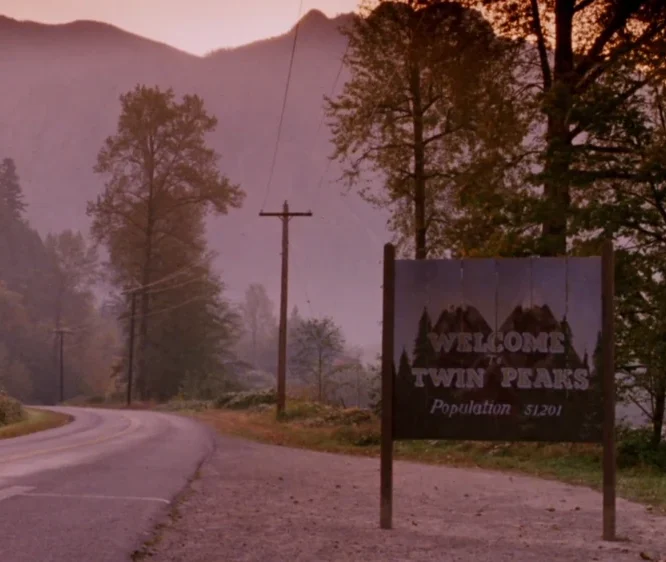
    And I remember watching Twin Peaks when it first aired on TV, but again I felt it was a bit old for me. I think it was when I came to watch it many years later that I really fell in love with all things David Lynch, to the point where he was probably my favourite filmmaker. No one else was as weird and imaginative and twisted. And yet, gentle and kind.

    This, more than anything, was what I (and doubtless many others) loved about his world. His villains were truly terrifying, but his heroes had a goodness and a kindness and an empathy that felt not only heartfelt but realistic. And my memory of that moment in movie and TV culture, no one else seemed to be interested in exploring the idea of Goodness.

    Perhaps my favourite film of his is The Straight Story, and this scene perfectly catches the aesthetic I grew to love.

    “The sky is sure full of stars tonight.” (The Straight Story, 1999)

    In fact, it was only after he died that I realised so many of the components of my own artistic aesthetic I ‘borrowed’ wholesale from David Lynch.

    But at some point in the 2010s I started to lose interest in his films. I hated Inland Empire, which I felt was overlong and incoherent, even though it had some great ideas. Had it been a series of 15 minute episodes, I might have loved it, but it wasn’t.

    And also, my attention started to move to the films of Hayao Miyazaki, who seemed to be interested in many of the same things but took them in other directions.

    But there was something else.

    Lynch had a knack for twisted erotica. No mainstream Hollywood director (and he was a mainstream Hollywood director) could do dark and sexy like he could.

    But as the 90s love of pulp fiction met the #MeToo movement, films like Blue Velvet, Lost Highway and Mulholland Drive started to feel exploitative to me. Was he just another male director playing with his beautiful actress sex dolls? There was something faintly Weinstein about the tone of those films.

    Well, it was heartening to learn after he died that both Isabella Rossini and Patricia Arquette were on record talking about how he created a collaborative, supportive and consensual work environment.

    And I would love to leave it there.

    But the recent revelations about Neil Gaiman give me pause.

    I stumbled onto this voice interview of Lynch, talking about his favourite film by one of his favourite directors: Stanley Kubrick’s Lolita.

    Many years ago I might have said “That’s an overreaction, surely. Kubrick is an iconic filmmaker and Lolita is one of his most celebrated films. It’s possible to greatly appreciate the film without condoning the behaviour of its protagonist!” (Which his grooming a minor, let’s be clear.)

    These days, however, I find it’s more useful to trust my instincts. And something about the way he talks about Humbert Humbert just feels… off, in a way I can’t quite articulate.

    I hope he didn’t have any dark secrets. I hope he was more Agent Cooper than Frank.

    I don’t know. I’ve learnt to give up on all my heroes, one by one. But not the beauty they produce. Kindness is kindness and empathy is empathy, even if it’s authors, like the rest of us, aren’t always perfect at maintaining that.

    And he was really good at empathy.

    For me, this is all of his traits wrapped up in one scene. Despite the world finally realising the kind and gentle soul he is, Joseph Merrick decides he will finally sleep “like a normal person”—knowing that, with his condition, this will kill him.

    Going to sleep for the last time. (The Elephant Man, 1980)

    “The sky is sure full of stars tonight.”

  • The Importance of Stuff

    The Importance of Stuff

    Photo by Toastt21 (CC BY-SA 4.0)

    We all have too much stuff in our lives, right? Material attachments. Clutter.

    There’s a whole corner of the internet dedicated to selling you a fantasy of living a truly minimalist life, without all kinds of shit on your walls or in your cupboards and drawers.

    In my teens and twenties I became obsessed with a kind of Westernised Buddhism, and I tried to detach myself from needing physical things like these. Actually, now that I think about it, to moderate success, because I didn’t become someone motivated by the desire to constantly own more things.

    But as I’ve got older I’ve realised that, whilst ‘material detachment’ still has its merits, it’s a big mistake to dismiss the objects we hold on to as clutter. The stuff around us, particularly in our homes, becomes part of who we are in a way that’s hard to articulate.

    Unfortunately, for some people, tragedy brings this importance into laser-sharp focus.

    If you’ve been on social media recently it’s been hard to miss TikToks of Palestinians finding their neighbours reduced to ash. (Although for many the loss of home and possessions is diminished by the loss of loved ones.)

    On a less brutal (but still pretty brutal) scale, for YouTube junkies such as myself, the Los Angeles fires have shown us in real time what it’s like for creators we’ve been following for years to lose everything.

    Van (brother of Casey) Neistat made this great video about how the fire nearly claimed his home and his work studio:

    In it he alludes to two other YouTubers who did lose their homes in the fires. Colin and Samir host perhaps the most popular YouTube channel in the ‘interviewing other YouTubers about YouTube’ niche. They often talk about how it took them more than a decade on the platform trying to find their way, and their road to success was a long struggle.

    Anyway. Here is their video which has just dropped:

    It’s a very well-made video, but it is just absolutely fucking heartbreaking.

    Imagine your parents escaped the India / Pakistan partition, and moved to LA in a mobile home, gradually working to the point where they own a nice house in the Palisades. Imagine their lives had been defined by being displaced, and finally they found a place where their children, and their relatives, could all live together as a big extended family. Imagine every single one of their homes, and everything in it, is just disintegrated in a matter of hours.

    Imagine you yourself have focused your whole career about being able to live in a stable, permanent community. Imagine you bought a house here a year ago, and spent the whole year painstakingly fitting it out. Imagine your wife is pregnant with your first baby, who is due any day now. Imagine you only moved in a couple of months ago.

    Both Samir and Colin are very insightful about what it’s like to lose everything, but still have the people around you be safe.

    Colin talks about how it’s not just the home or the stuff: the memories that the stuff reminds you of are now also gone. For Samir particularly, there might be an object that reminds you of that thing you did in the park next to the house where you grew up… and every single one of those things has been destroyed.

    The key lesson of this tragedy – the moral – as far as I’m concerned, is that sometimes there is no lesson, no moral. There was nothing that they, or their neighbours, should have done to avoid this. They could have not bought a house there, but everywhere is vulnerable to something. This was just a natural force that humans couldn’t control.

    But it can highlight things that were true before.

    People—family, community, friends—are what really matter. But still, ‘stuff’ is underrated.

  • Pulp and the 90s glamorising of Northern working class culture

    Pulp and the 90s glamorising of Northern working class culture

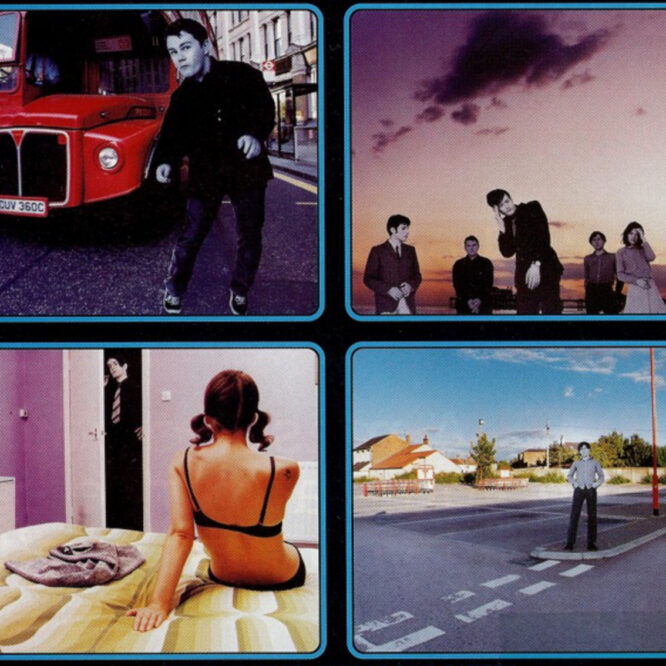
    In the late 90s, I think all of us skinny indie boys were a bit in love with Lauren Laverne.

    Now the respectable presenter of BBC Radio 4 Desert Island Discs, she was once the snarkiest, brattiest and just plain funniest person in English indie music. She could pack more wit into a sentence than all of the 30 something music critics put together.

    This is perhaps her biggest hit (although it’s technically a guest feature on a record by Mint Royale) and it’s called Don’t Falter:

    It’s a family favourite of ours. It’s in our big YouTube music video playlist for the kids. We even played it on our wedding day.

    I was watching the video this morning, and I suddenly got a pan of nostalgia for my student days – not something I get that often. I was never a very good student, but I fell in love with Liverpool, the town where I went to university.

    This video always reminds me of the Costcutter at the end of our street, and the energy of a northern city in the late 90s. But more generally it reminds me a certain kind of cultural aesthetic that I really miss.

    I first noticed it with Blur, even though Damon Albarn openly admitted it was a sneering and patronising take on working class life (“I’m a battery thinker / Count my thoughts on 1-2-3-4-5 fingers”).

    Then came Oasis. And if you weren’t there it is simply impossible for me to overstate how big Oasis were in English culture in the late 1990s. If you didn’t make a show of being a super fan, you might as well go and live in the woods. I respect much of what Oasis did, particularly how masterfully they manipulated the middle-class media pseudo-lads who worshipped them so much. But stylistically, I always found them to be quite a narrow mod rebranding of the Stone Roses – which was fine, but there was a lot more innovative stuff going on.

    It was really the band Pulp that cemented this aesthetic I’m writing about here.

    They took the bright colours and cheerful branding of budget supermarkets and other forms of supposedly cheap design, and they celebrated them. And instead of using their class background to make themselves the new Beatles, which is what Oasis did, they actually wrote about what life was like outside the London bubble.

    I feel like it’s kind of unimaginable that Common People would be a hit now. Not because the public wouldn’t like it, but because no mainstream outlet would give it the time of day. Imagine the knuckle-wrapping that any favourable critic would get from the angry billionaire boss or their proxies.

    Now, I was always this posh tourist in the north of England when all of this was blowing up. I never had any illusions about being ‘one of the common people’, and it’s not something I aspired to.

    But I really miss living in a culture where, y’know, they even exist.