
We are… not suffocating – just bored.
September 2026

Why are we waiting?
I’ve written many times about how I believe the world fundamentally changed after Trump was re-elected. And we have spent the time since that re-election watching a global order car crash in slow motion. However… the US midterm elections approacheth, and it looks likely that Trump and his party will lose a significant amount of his (democratic) power. What will it actually change? Will he find a way to sabotage the process? Will the Democrats actually do anything if they win?
Trump 2.0 has dominated online conversation, and that has clearly been by design. News and politics and current affairs have squashed out pretty much everything else, and the big cultural events – new films and books and albums – now have to say something about the current moment in order to cut through the noise.
But I feel like this international doomscroll has quietened down recently, and the world is in this strange limbo, waiting for the US midterms.
Waiting for the promise of things going back to normal – a promise no one actually believes anymore. Waiting for the AI bubble to burst. Waiting for the Iran oil shock to really hit. Waiting for El Niño to peak. Waiting for Russia to invade another Baltic state. Waiting for the next country to elect a neofascist.
Once again, old world dying, new world yet to be born, time of monsters, yada yada yada.
The one thing that everyone online seems to be focusing on right now… is actually sports!
I think anyone who is remotely a sports fan is choosing to focus on that because it’s one of the few reliable shared talking points left. It doesn’t depend on what’s happening in politics or the economy or the environment.
Culturally, though, I feel like we’re treading water. I certainly feel like I’m treading water – I’m tired of thinking about, and writing about, the same things plutocracy, climate anxiety, AI…
But I’m still working my chestnuts off trying to get this freelance job off the ground so I can earn myself back some free time. So I’m not in a position to do much apart from that, much though I would love to just get back to making some music.
Instead, this month I’m going write about the music I would make if I had the bandwidth. Just to reset my compass, so to speak.
And also sorry, I’m going to write a bit about AI, because 2026. When big changes happen, I feel like I need to process them, and this newsletter can be a useful tool for doing that.
Another mixed bag of random miscellaneous recommendations first though…

Advanced Warning…
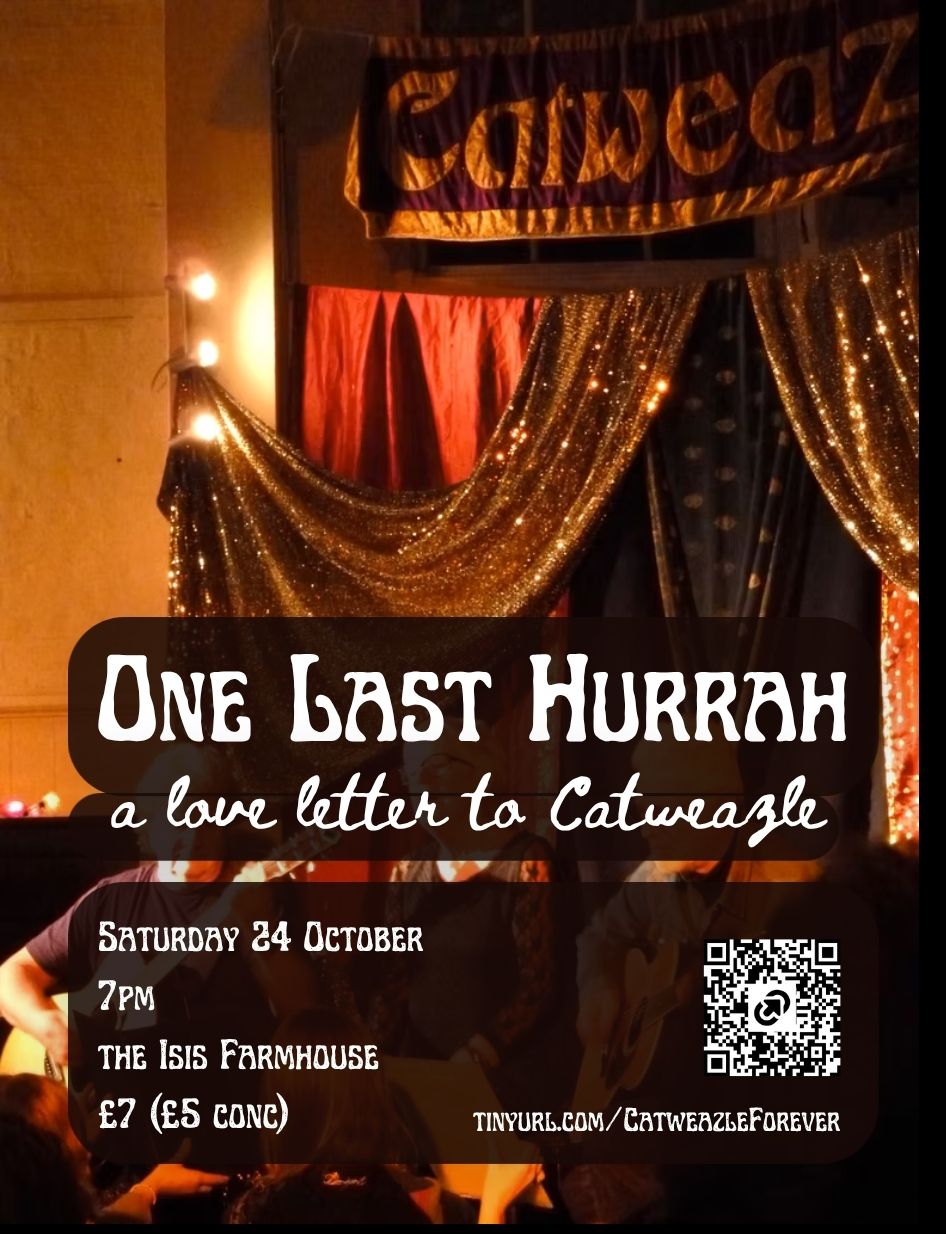
CATWEAZLE: ONE LAST HURRAH
Okay, I had just hit send on last month’s newsletter when I realised I’d forgotten to add the great big Catweazle celebration that I’m helping to organise this month.
Now, because this newsletter now lives on my website I did then just go and add it – but I want to make more of a hullabaloo about it this time.
I’ve gone on about what Catweazle meant to me so many times over the years. It’s where I made most of my adult friends. It has reshaped my view of the world. And it gave me the experience of being embedded in a supportive community of artists that I feel privileged to have been a part of.
I think this video of my brother and I butchering Leonard Cohen’s legacy over a decade ago captures what I loved about it perfectly.
Anyway, this newsletter does actually have an event section which I wish I could put more in – for years now it has just been my monthly folk session. But now I get to add the details to this Catweazle event too.
Tickets are also available here.
Now, it’s an old promoting trick to say that “tickets are selling out” even if they’re not. But we sold 100 tickets more than a month before the night, so I think it could be busy.
Recommended
‘GALILEO’ by THE INDIGO GIRLS
This has been one of my favourite songs since my late teens, and until recently it never occurred to me to see if there was a video.
It’s very 90s.
How can I explain what it was like to be into music in the 90s?
Yes, there was a lot of exciting ‘cool’ music (particularly in the UK and Europe, in what I suppose you could call ‘arthouse electronic’ music). But there were also a bunch of musicians who were prepared to go deeper – to analyse their lives, embrace the passion, embrace the occasional cringe, laugh at themselves for being pretentious, and actually try to make sense of life. It was a time when even pop songs had lyrics like “What if God was one of us? Just a slob like one of us? Just a stranger on the bus / Trying to make his way home?”
Sigh. Our cultural lives were dominated by the ‘top ‘Self-Actualisation’ put of Maslow’s Hierarchy of Needs. I miss it so much.
Anyway, I think the Indigo Girls, and this song particularly, are the perfect example of that.
As the bombshells of my daily fears explode
I try to trace them to my youth
But then you had to bring up reincarnation
Over a couple of beers the other night
And now I’m serving time for mistakes made
By another in another lifetime…
Recommended
DAISY CHAIN FIELDS FESTIVAL
A few newsletters back I wrote about how much I enjoyed the documentary on Lilith Fair: the festival in the late 90s that had all of my musical heroes performing (and which the Indigo Girls formed a crucial part).
Quick recap: Canadian singer/songwriter Sarah McLachlan got frustrated with the limited opportunities for women in the music industry, so put on a festival to help rectify that. Not only was it financially successful but everyone who attended speaks about it like a religious experience.
That documentary also answered a question I’d always wondered: when McLachlan passed the baton, why did no one else pick it up? Why was there never another Lilith? Here’s the downer: she came back and tried it again in 2011, and by her own account it was a failure. Personally, I put that down to the music industry having changed: that was peak Spotify-Eats-The-Music-Business and, if your parents couldn’t fund you, your chances of success were pretty low.
So, you know that Olivia Rodrigo? Woman of the moment? She cropped up as a talking head in the Lilith documentary saying “Wait, why did no one tell me there was a festival with all my heroes in?”
Well, anyway, she just went and did it. Daisy Chain Fields festival.
You see, she saw what people like me missed: you can’t just reboot it, you need to make something new.
A lot smaller than Lilith at its peak, I think, which is probably sensible. I get the sense she’s building it carefully, and building it to last. Artists list: Chappell Roan, Doechii, Alanis Morrissette, Bikini Kill (from my vintage)… fucking Stevie Nicks! Big names. And as far as I can tell, everyone loved it.
The idea won’t die, it seems.
Recommended
INDOOR KAT (again)
I know YouTube videos are the things I keep recommending. They’re easy to recommend because they’re easy to embed into the text.
But to be honest, I’ve fallen out of love with YouTube (and all big tech platforms) since they started kissing Trump’s ring.
That said, Indoor Kat reminds me how much great stuff there is on the platform.
I think I’ve described her here before as a gentler (and arguably deeper) version of Casey Neistat: she makes videos about living in New York, and… that’s kind of it. But each episode is like a scene from Amélie.
In this episode she squares off with a cockroach, and spirals about turning 40.
Oh, and one little thing I just noticed, that I love: she never asks you to subscribe or click the bell, and she isn’t dying to know what you think down in the comments. She’s not hustling – she has a day job. She’s just doing it because she loves doing it.
Recommended
LUKE NICKEL
I had a feeling we might get a new crop of American folk singers in the Woody Guthrie / young Bob Dylan vein, as we seem to be drifting into the dustbowl 1930s. Jesse Welles is perhaps the biggest name right now.
But Luke Nickel is the one who I think has been nailing that role the best recently, and this song is a great example. Other classics include 47 Ways To Use A Guillotine and Let’s Go To Epstein Island.
He’s adding the element the others miss: shit-posting.
Recommended
EXAMINING RAGE BAIT with TUNNEL VISION
I’m making a lot of references to my recent newsletters, and here’s another one. I’m really liking what Johnny Harris’s Newpress is doing with journalism online (which I plugged recently), and this is video is part of their series called Tunnel Vision, presented by former Vox colleague Christophe Haubursin.
It’s a deep dive into the AI-generated political hate videos online, particularly in the UK, particularly on Facebook. And Christophe doesn’t seem to be interested in what is sensational and clickbaity – only with, like, what is actually going on.
This is journalism where I actually feel properly better informed, like I understand the underlying systems.
Spoiler: it seems online rage bait is actually not funded by billionaires, but it absolutely is incentivised by them.

Upcoming Events
Friday 9th October

Saturday 24th October

Dear Diary…

Right, let’s do this.
If I was to write some music right now
I wouldn’t write anything epic and ambitious. I wouldn’t write about The Current Moment. (Not that that’s bad, but this would be me writing for me – and trying to remind myself the good things that came before, and might come after.) I’d like to write something really specific and niche. Poetic and weird, maybe in a Nick Drake vein. Originals, not Trad right now. Melody over riffs, definitely.

Okay. Let’s take it a bit further.
If I was to make my next cult classic film
Cinemas (as in the actual buildings) have been enshittified into these sad husks. They feel like run-down running shoe shops selling sweets to children. If you’re not making an IMAX movie in 2026 then you need to persuade your audience to leave their home and pray at these temples to asset-stripping. I don’t want to make a cinema movie, or a streaming movie. I want to make a drive-in movie. I want to make a Roger Corman horror movie, in black and white. Some full-on German Expressionist shit, with the frame broken up into shards of pure darkness and light. Maybe even with splashes of colour. Okay, yes, I am thinking of a look similar to Sin City. But for grown-ups (rather than angry/horny incels).

If I was to write my next sleeper hit novel
When I daydream about writing a novel, it tends to be about something like exploring how a crisis affects a whole community (because that’s the kind of depth you can’t go into with most other media). But that’s not what I’m feeling now. Again, I would want to write something very genre-driven and specific. For example, I might want to lose myself in the mechanics of planning a crime. I might imagine a morally dubious character putting a crew together and planning to steal, say, Elon Musk’s entire fortune. And we’re left guessing until the end whether this is a purely selfish project, or whether there is actually some deeper principle at work.

If I was to give theatre a new lease of life
More horror, for some reason. When horror works in the theatre… when things start to get a little strange, and unreal, and you get this sense of dread like there might be something very weird and very powerful and very evil in the room, and it’s starting to affect the cast, and it will affect you soon, it’s just more exciting than horror in a cinema. It feels like you’re a part of it.

If I was to redefine opera
Don’t be fucking ridiculous, I’m not going to write an opera – even in my imagination. Do you have any idea how much work that is?

What I might actually do next instead
In every newsletter I whine about how I don’t have the bandwidth to do anything creative. I get periods of time when I can be creative, and I’m in a long spell where I can’t (except this newsletter and the Bastard session), but all things must pass, even this. When I do have time, realistically, I think the first thing I’m going to work on is developing tools to embed AI poisoning in recorded music. Seriously. I feel like that’s what’s next for me. And if I’m confident that these tools work, I’d like to share them.

So What Have We Learnt?
So, here we go. AI. Can’t escape it.
I’m sorry, but I’m going to go loooooong on how I think AI is going to affect the global economy.
For my own benefit, really – just so I can get my thoughts in order. Because I think there have been a lot of interesting developments recently.
I’m not going to speculate on how AI will affect climate change or the creative arts or politics, because I feel I have much less of a clear idea. But I will focus on how I think it will affect jobs.
Basically, I think the Chinese have figured it out.
Where the American AI industry has been focused on how to make the first crop of trillionaires, the Chinese approach has been to make a bet on where AI might actually be useful.
From what I can tell (at least in part from this analysis), they’ve decided to make their AI models free and customisable, so that every Chinese business can use them, or not use them, as they see fit. Perhaps to increase output and efficiently. Perhaps to make higher quality products. But AI is not an end in itself: it is a way to make businesses work better.
I think it has taken time for the rest of the world to figure out this is the Chinese strategy, but it’s starting to sink in now. And I think the American AI companies are going into full panic mode.
OpenAI and Anthropic clearly thought they were fighting each other for the most important tech monopoly in history, and it never occurred to them that China would be competitive, because the US had banned China from the most advanced microchips. But China found ways around it. (Did these Chinese companies steal from the American models? Obviously, yes. Then again, the American AI companies stole from basically everybody.)
Now, as far as I can tell, businesses in the West are starting to discover the advantages of the Chinese models: they can run them on their own servers (and therefore not send all of their sensitive data to Sam Altman), and they can customise them to better suit their business needs.
I think this is why American AI companies are now begging for regulation ‘to slow them down’. I think their best case scenario is that they convince the US government that AI is so powerful and so dangerous that these free Chinese models should be banned, and the only AI allowed should be OpenAI and Anthropic, closely supervised by the government.
If that doesn’t work (and I don’t think it will) then I think they have a fallback plan. Proclaiming to the world they should be forced to slow down is a convenient cover story for the fact that they have massively over-promised what their AI can do. They have raised hundreds of billions based on the assumption that they are building Artificial General Intelligence (AGI), and it’s becoming clear that’s never going to happen – but if someone has ‘forced’ them to slow down then they can at least pretend that’s the reason.
That’s why I think there is this consensus building that “The robots are going to kill us all!” is actually skilful PR.
In fact, there is a great YouTube video by House of El which really clarified my thinking on this. El quite reasonably concluded that these claims from CEOs and AI experts must be based on reputable research. Right? So she went to look for the research papers that the panic was based on.
She found 12 papers, and they led her to a really interesting conclusion. AI is meaningfully improving work productivity, sometimes dramatically. More than that, there is evidence that these models are improving ‘recursively’: they are able to improve themselves.
However, she offers a very important caveat that undermines this particular AI doom story. AI is only achieving recursive improvement in a few select areas, and they are the areas where it is possible to verify success with certainty. Did they find a mathematical proof? Did the code they wrote actually work? In areas where their results are difficult to verify, we’re not seeing very good results at all.
Okay, so if this technology is not so powerful that it will kill us all… indeed, it’s underwhelming enough that the AI labs need to keep hyping them up with scare stories… where does that leave all our jobs?
El makes the point in her video that studies show AI has not really improved business productivity. Yet. But that probably will change.
She gives the example that the electric motor didn’t improve factories much when it replaced diesel motors. But then the next generation of factories were built with completely different floor plans and power systems and work processes, and that was when the productivity spiked.
And she mentions Jevons’ paradox, in which the eponymous 19th Century economist observed that better technology did not produce less work that was more efficient. It produced cheaper work, and lots, lots more of it.
So I don’t think AI is going to kill all our jobs. I think it’s just likely to change them, and to create new work processes.
This is not a new idea, and lots of people have been saying this about AI for a long time. But hanging over that has been the question: what if AI is different? What if AI really is more important than fire, as Google CEO Sundar Pichai has claimed?
I feel like now it’s pretty clear that’s not the case. AI is a hugely significant technology that will change how economies work, but it’s just a technology, not an act of (digital) God.
All of this is a very long rambling build-up to the thing that I feel like I’ve really learned this month, and it comes from this interview with Mike Cannon-Brookes, CEO of Atlassian. He suggests one intriguing way in which AI could change how we work.
He talks about how a lot of businesses were based on ‘information asymmetry’. You hire an accountant or a lawyer because they have information you don’t.
Now, he is quite specific in saying that we will still need experts, but the boundaries between each expert’s job will get fuzzy. In a software company like his, designers will write code and software engineers will do design. But you will still need designers and software engineers, because they have the judgement and the taste.
And is this last point that I think is really interesting.
He suggests that we won’t have an information asymmetry in the same way. We will have an imagination asymmetry. The businesses that will adapt the best are the ones that can be imaginative and creative. And to be imaginative and creative, you do need to be an expert, because you need to have that all-important judgement and taste that large language models lack.
Is this being wildly optimistic?
Well, I deliberately haven’t written here about oligarchy and plagiarism and climate impact, so there is still a whole swelling septic tank of issues to deal with.
But I think China is already making a bet on AI enhancing jobs rather than replacing them. And it will be interesting to see how it plays out.

Ask me things

If you have any questions then seriously, do please leave a comment or drop me a message here. About life. About the universe. About anything really. Just not about AI. Or opera.
Photo Credits
- Click on the images to see the originals. (It just means less admin for me this way.)
You must be logged in to post a comment.