I’ve been predicting that the United States would erupt into violence before the end of Trump’s second term. I couldn’t see how that could be avoided. His administration was systematically taking away every means of legal resistance, and normalising violent cruelty as an everyday political tool.
But now it seems the Republican party is going to get wiped out in the midterm elections, and whilst the deep deep tensions in US political life will carry on after that, I’m not sure the Trump administration will survive.
They will certainly try to rig the election any way they can. Perhaps they will be successful, in which case my previous prediction still stands.
But there has been a chain of events that I didn’t predict.
I didn’t predict the impact of the Epstein files, which probably prompted the Trump administration to invade Iran. I don’t think the administration considered invading Iran was a big deal – after all, invading Venezuela hadn’t been.
The Iran conflict is now arguably a bigger scandal than the Epstein files, because he has basically ended US military dominance. He has just publicly, and very embarrassingly, lost a war, and possibly crashed the Western economy.
One of the defining characteristics of the Trump administration and the supporting Republicans up to now has been that they have been bold. They have known that the Democrats don’t have the will to stop them, so they have taken outrageous step after outrageous step, and whilst they haven’t always succeeded they have never been punished in a meaningful way.
So it seemed pretty obvious that they were going to rig the midterm elections in whatever way they could, and if that didn’t work they would try to cancel them altogether. If they were successful then great, but if not then it’s not as if they were going to get punished for trying.
However, they have messed up the Iran war so badly, as a way of trying to distract from the Epstein files, which they have also messed up in a catastrophic way. And then there is the fact that Trump’s health is visibly deteriorating.
I think they’ve just lost the plot.
If so, what does the future of the United States look like?
Probably more of a managed decline. The world will probably be thrown into another financial crisis caused by the US, but this time I think it’s likely that nations will focus on forming and strengthening alliances outside of the US global order. Which will reduce American economic might, which will reduce American military might, which will American reduce political influence.
Domestically, I imagine Trump will be replaced with rogue’s gallery of imitators, who will probably be discarded fairly quickly, until eventually someone else can become build the public support that Trump did.
In the meantime, there might even be some kind of radical overhaul of the Democrat party. Maybe some kind of Keynesian New Deal, combined with aggressive taxation of billionaires, might stabilise the country.
If that doesn’t happen (and I personally don’t think it’s likely) then the US will be back where it started – and then there might be civil war.
But that could be a decade away. A lot can happen in that time.
When Barrack Obama first stood as a presidential candidate, I confidently predicted that the US would never elect a Black president in a billion years. I was very happy to be proved wrong.
If the US avoids civil war or revolutionary violence, and particularly if the MAGA movement collapses and it is able to transition to a more progressive political structure, I will be even happier.
Three big things this month that I think deserve a closer look.
1. What happens if the US sends troops to Iran and they rebel?
I’ve been theorising in my little newsletter for a long time that the endgame of the Trump administration is when they lose the Armed Forces. I feel like this endgame could get a whole lot closer if the US sends ground forces into Iran.
There’s precedence for this. A seldom-talked-about phenomenon is that towards the end of the Vietnam war the US armed forces were essentially collapsing. GI resistance movements were springing up left right and centre, and the practice of ‘fragging’ – using explosives and grenades to wound and kill senior officers – was becoming increasingly widespread.
It’s perhaps unsurprising this isn’t talked about, as it undermines the standard narrative that the problem was unpatriotic media and dissent back home and that, if the military was just left to get on with it, they were close to a decisive victory. They weren’t. The army was falling apart.
It’s also unsurprising that, with Vietnam in living memory, the George W Bush administration was so keen to declare victory and an end to the Iraq war at the first possible opportunity. The strength of the government depends on having functioning armed forces, and being able to back up decisions with extreme violence if necessary. Once that goes away, foreign adversaries and domestic resistance movements start circling like sharks.
I think this is why a swift and humiliating retreat from Vietnam was the only sensible strategy for the United States in the early 1970s. If it had become clear to the Soviet Union, at the height of the Cold War, that the United States was militarily impotent (despite being having best-funded military in the world) then maps might start getting re-drawn and the Cold War might start getting hot.
Is the Trump administration’s current war with Iran likely to be more popular, or even as popular, as the Vietnam war with US soldiers? With the disaster of the Iraq and Afghanistan wars in the recent past, I think it’s reasonable to suggest Iran will be much less popular than Vietnam.
So what happens if the US Armed Forces, the final enforcement of Trump’s authority, refuse to fight and mount resistant campaigns like the ones in Vietnam? Many prominent figures in the MAGA movement have been advocating for a new American Civil War. However, if the Trump administration loses control of the Armed Forces in Iran and any domestic resistance movement starts to push for civil war, the Trump administration won’t realistically have an effective way to fight back. Knowing Trump, he might want to bomb his own citizens, but he wouldn’t be able to drop those bombs himself.
We’re still a way away from this kind of crunch point. But if you’re curious what it looks like in practice…
2. Bluesky CEO & founder Jay Graber steps down
There was a point in late 2024 when Jay Graber, founder of Bluesky, was arguably the most important person in tech. She was the creator of a social media platform that seemed to be billionaire proof, to the extent where she personally trolled Mark Zuckerberg. [world without caesars]
However, the platform seems to have lost a lot of its momentum. And there were questions about how truly billionaire proof it could be when it was funded by venture capital.
So, when Graber announced this month that she was stepping down as a CEO and would be replaced by a literal venture capitalist, this might seem to confirm the critics worst suspicions.
If you’ve read anything I’ve written about her in the past, it’s pretty obvious I’m something of a super fan. And it’s perhaps unsurprising that I have a different take.
I do think this is a really big deal, but it’s probably a positive one, and the right step for Graber to take.
Because she didn’t just step down as CEO. She technically demoted herself to chief technical officer. This means she is less focused on the Bluesky app itself, and more focused on the ‘AT protocol’ that it runs on.
For the fan boys like me, the protocol (which Graber built) has always been more exciting than the app, because it means if the app gets ruined in any way, you can take all your data and posts and social interactions and move them to another app on the same protocol. This is the reason why it’s billionaire proof.
This is all the more important in the Trump era. I think Bluesky was designed for the Biden era, when authoritarianism was knocking on the door but not making itself comfortable on your sofa.
I think the reason why Graber accepted funding from venture capitalists in the first place was because Bluesky was always just the shop window for the underlying protocol, and she wanted to grow it as quickly as possible to spread the word.
However, sooner or later venture capitalists are going to want a return on investment, and enough time has passed that she may have had to make the choice: pivot to making Bluesky profitable, or leave that to someone with a successful track record and instead focus on innovating the protocol.
I can see why she would’ve chosen the latter.
At the end of the day, Bluesky is just another Twitter clone, but the potential for the AT protocol ecosystem (‘the ATmosphere’) is pretty much infinite.
3. Kat Abughazaleh loses
Last year, independent journalist Kat Abughazaleh announced that she would be running for Congress in the 2026 Illinois Democrat primary.
10 days ago, she lost that election.
This is significant, because usually the winning candidate has a kind of energy behind their campaign. It’s the campaign everyone’s talking about. And Abughazaleh’s campaign was talked about around the world. You could feel it from across the Atlantic ocean.
She campaigned with an even more direct anti-oligarch tone than Bernie Sanders and Alexandria Ocasio-Cortez. She was scathing about congressional Democrats. And her slogan was “What if we didn’t suck?”
She lost to a slightly more progressive establishment Democrat. Daniel Biss is a local mayor who seems to be popular and has lived in the area much longer, and this was Abughazaleh’s first foray into electoral politics, so perhaps this shouldn’t be a surprise. However, she came second out of fifteen candidates, she lost by only 4%, and without any of the major donor funding her rivals.
Above all this, however, the way she ran her campaign has been the talk of online politics. Her funding came from ordinary people instead of rich donors, and she spent the money directly on projects that helped her community. She frequently protested outside her local ICE detention centre, and got assaulted by ICE goons on camera.
In short, she proved to be the antithesis of the ‘politics as usual’ which voting citizens have grown to despise the world over.
Many, including myself, were expecting another Mamdani moment, but it didn’t happen. Why not? Everyone has their theories, but it’s hard to escape the issue of ‘Dark Money’.
Once upon a time, there was at least the pretence that political candidates had limits on the amount of money they could spend on their campaigns, even if Rupert Murdoch could spend whatever the hell he liked and would always get his preferred choice. Now, in the age of cryptocurrency, even that pretence has gone, and dark money is just the new political reality. Elections are pay-to-play.
It’s notable that both Biss and Kat were both on the receiving end of huge dark money attack campaigns, but in the final week, when they were both tying in the polls, Biss’s attack ads were all taken down and the attack ads against Abughazaleh intensified. In fact, in the final week a secret campaign was launchedoffering TikTok influencers $1,500 for every negative video about her.
I think there are many of lessons to learn here.
One is that financially supporting slightly more progressive establishment figures, in combination with infinite attack ads, might be the standard strategy for defeating candidates like Abughazaleh.
But for those paying attention, I think the biggest lesson is that Abughazaleh’s campaign was so effective that only an openly dirty dark money campaign could defeat her, and even then only narrowly. And even then, perhaps just because this was her first election.
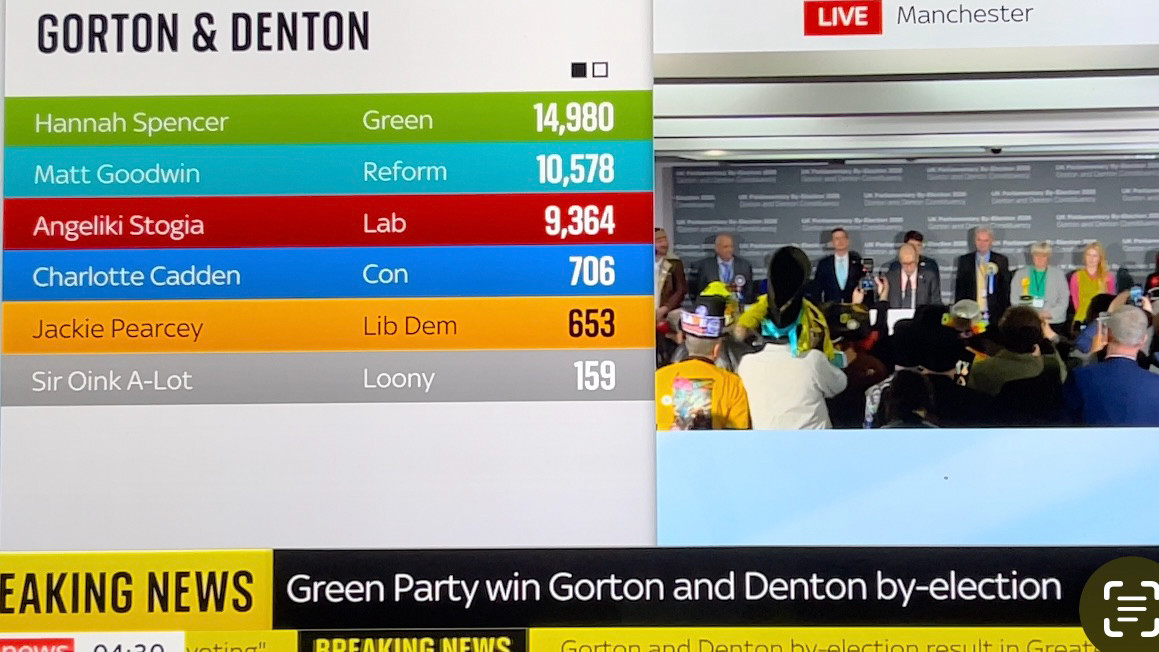
UK by-elections generally don’t make that much difference, but the victory of the Green party yesterday in Gorton & Denton might be the biggest thing to happen in British politics since… pretty much as far back as I can remember.
I want to explain why – mainly to myself because I’m still processing it.
Below is a video from the Anywhere But Westminster series made by John Harris at TheGuardian.
In this series he goes to UK constituencies and just talks to people. In terms of UK politics I think this is the best journalism we have, because it quickly becomes clear where the voting intention is.
Watching him visit and talk to the constituents in Gorton & Denton, it seems so clear to me that the Reform party were going to win.
So many people, when asked what they cared about, focused only on the Reform talking points. Reform seemed to be running a very effective media strategy that was dictating the conversation.
Reform’s chosen candidate, Matt Goodwin, didn’t seem like the kind of candidate who would resonate with that area, but I suspected that didn’t matter. Years and years of the Reform narrative via mainstream media would have done all the heavy lifting here.
This also seemed to be the general trend of British, and indeed global, politics: when it came to an actual election, the candidate furthest to the right kept winning.
So I was confident that, despite the optimism around the Greens, it would be a Reform victory – and a comfortable one at that.
The Green party won. The Reform party lost. I haven’t been this happy to be wrong since Barack Obama won in 2008.
I don’t, however, think this is an indication that the Green party will win the next general election. I don’t even think it’s a sign that Reform will lose it.
The reason why I think this by-election is so important is that it feels like the a smoking gun in terms of understanding what has been happening in British (and global politics) over recent years.
For so long, we’ve been talking about the rise of the Far Right. Mysteriously, at every election, the energy and momentum is behind Far Right candidates.
What I think this by-election (and, incidentally, the election of Zohran Mamdani in New York) shows is that we are not witnessing the rise of the Far Right so much as the collapse of the Centre.
No one is voting for the Centre Left and Centre Right parties.
If you look at the way both the Labour party and the Conservative party fought this by-election, I think it’s not hard to see why. They are just not doing the work.
They are complacent, they take their strengths for granted and don’t have a good understanding of their weaknesses. They are cynical and they follow outdated electoral strategies.
Up to now, the only candidates who have been able to take advantage of this are Far Right candidates, because they have the backing of billionaires. However, with each progressive candidate victory, it’s becoming clear that they can win too.
This isn’t necessarily great news for progressive though.
Most countries have media ecosystems that are owned by billionaires, and that obviously gives the Far Right a huge advantage.
The reason why I feel a lot more optimistic today is because the Green party won even though that video above really seemed to suggest the mood in Gorton & Denton was sympathetic to Reform.
So how did they win?
Something interesting about the result, if you look at the numbers, is that there was a clear split between the parties that really made an effort and the ones that didn’t.
Many people, myself included, thought Labour would get spectacularly bad numbers. They didn’t. They weren’t that far behind Reform. So I take it that this time they decided to make the effort and go out and talk to people door-to-door.
That’s what I think won this election: good old-fashioned face-to-face canvassing. Perhaps that video was unrepresentative, but the Anywhere But Westminster video series has generally been an excellent barometer of previous elections, and I can’t think what else could have turned the mood in the favour of the Greens..
I think this election shows that progressive candidates with a clear positive message who put in the work of talking to their constituents face-to-face can outperform candidates with the backing of billionaire media. And they can do it comfortably.
That doesn’t mean this will keep happening. I imagine Reform and other billionaire-backed parties will go home, regroup and come back with some new dirty tactics.
However, this suggests that the old-fashioned approach of talking to constituents face-to-face is more effective than the toxic media bubble.
And, at the very least, that gives all of us anti-fascists a fighting chance.
So, 2026: new format, new ideas, new regular feature.
In the days after Trump was elected, I made this video:
TL:DW is that I can see a fundamental obstacle to being an artist under an authoritarian regime: either you make your art about what the regime is doing, in which case they kind of win, or you ignore it, in which case you are tacitly treating it as normal, in which case you are tacitly endorsing it, in which case they win.
I feel like it’s difficult to have something to say, however small your audience, if you’re not addressing the rampaging elephant in the room. But it can’t be the only thing you have to say. As we say now: joy is resistance.
So I want to pull all my thoughts on the current state of world politics into a regular, but separate, article which readers can dip into if they’re interested, but which they can just avoid if they want to.
This is the Quiet Part Loud.
Part 1 – Minneapolis: the seeds of the US resistance movement?
January 2026 feels like a turning point. Although feelings can be deceptive, because thinking back it also feels like every single month for at least a year and a half is some kind of turning point.
The year began with a dramatic escalation from the Trump administration, and I’m not going to list all the drama. However, out of all of it I think the world’s gaze has turned to the ICE occupation of Minneapolis.
And just to add this explanation once again: whilst this is a domestic US crisis, the US is still effectively the global bank, police officer, court and media provider, so I believe we should all pay attention.
I want to start by focusing on a disagreement between two influential American historians. Professor Heather Cox Richardson, who I have recommended in my newsletter, has writes a daily letter explaining the current US crisis in terms of its history, and it is read by over a million followers on Substack.
In this recent video she urged her followers to put pressure on congressional Republicans, but right now only they have any power.
Enter rising star Tad Stoermer.
He is also a scholar of American history, but specifically resistance history: those times when effective resistance movements were built and changed the countries political direction.
His latest video responds explicitly to Richardson, and other moderates, who are suggesting that Americans just need to appeal to the better nature of an openly fascist government in the middle of an uninterrupted power grab.
He is utterly scathing.
The TL:DW of this is that history tells us no attempt to appease or persuade a tyrant has ever worked. Ever.
And to suggest that only congressional Republicans hold power now is to basically give up on democracy. Power exists beyond congresses and parliaments. Citizens can resist, agitate, push back, put the regime under pressure.
Stoermer makes the point that finally we’re seeing this in the United States, in Minneapolis.
But there is such a stark, shocking disconnect between the cowardice and inertia of the Democrat leadership and the energy and activism on the ground.
About an hour ago, YouTube just fed me a great example of this: an interview with a community organiser.
Aru Shiney-Ajay describes how they all can feel the fear of living in a military occupation, but the amount of solidarity, compassion, organisation and community is like nothing she’s ever seen in over 10 years of activism.
Citizen patrols are walking the streets, and when they see ICE operatives they message their Signal chats, and then blow whistles, which summon more citizens, until eventually they outnumber ICE considerably, and the ICE abduction is aborted.
Now.
I don’t want to suggest that’s American fascism over with. It’s barely begun. But I find it hard to imagine these citizens will go back to normal after this. Once they are routinely risking their lives for each other, the desire to avoid conflict in case ‘things get bad’ is gone.
A smart government might try to roll this military occupation back, and try it incrementally at a slower pace when the country isn’t watching.
This is not a smart government.
And, although it is still early days, there are some who are saying that Trump has already lost ‘the Battle of Minnesota’.
Here’s Jamelle Bouie of the New York Times:
I’ll round up this section by taking a little detour.
There’s a creator I’ve been following – a trans academic studying the far right whose social media handle is Nope Brigade – whose videos have been getting more and more… well, terrified.
After the Charlie Kirk assassination, they said they were contemplating fleeing the US. Then they said they had decided it was time.
And then they stopped posting. For weeks.
Every now and then I’ve typed ‘Nope Brigade’ into my search, but nothing new came up.
Then, a few days ago, they posted this:
I try to remind myself, when I find myself drawn from the safety of my sofa into who is winning the sport of right vs left, that the horror has already begun for so many people.
We still have time to stop that horror spreading to the UK. But that time will soon run out.
Part 2 – Even the masters of the universe are spooked
The World Economic Forum held their annual event at Davos this month. By most accounts, the Trump crowd turned it into an absolute clown show. Here is a highlight reel:
I found this video from US media’s favourite rich smart-arse professor Scott Galloway:
I think Galloway is often funny, self-deprecating, insightful… but also a good representation of how the rich are living in a different reality.
And I think he knows it. Indeed, that video is basically Galloway talking about how none of these ‘masters of the universe’ – politicians, tech gurus, financiers, celebrities, etc. – really know what’s going on.
He talks about a sense of unease they all have. Like what’s coming next is going to be bad for everyone.
That surprised me for some reason. I suppose I imagined that it would all be a bunch of ashen-faced minions sitting round a big table while a masked chairman taps his fingers together and says “Goood… everything seems to be going to plan…”
Once again, it makes me feel like the big story of the moment is not about a bunch of Silicon Valley geniuses overthrowing democracy, or a Republican party full of mannequins being operated by unknown billionaires.
It’s about a political establishment of what David Graeber called ‘extreme moderates’ who will do anything, will cross any moral or legal line, to appease their opponents. Leaving their opponents victorious… but confused and disorientated. Like naughty children desperate to know where the boundaries are.
Let’s talk about those Silicon Valley geniuses though. Let’s talk about the modern media landscape.
Part 3 – They shoot horses, don’t they?
On New Year’s Eve, Head of Instagram Adam Mosseri published a blog post about his predictions for the future of the platform. And everyone’s been talking about it.
I’ve seen a bunch of creators complement him for his honesty and insight, and discuss how to tweak their content strategies going forward.
But for those of us who have decided to get off that ship and paddle to our own little open-web island, he… well, he said the quiet part loud.
Mosseri talks about his concern that AI slop will soon flood Instagram, and it will become impossible to establish what is real.
He suggests that, now more than ever, the creators who can be real, authentic, transparent and consistent will be the ones who stand out.
Yes, we have already enshittified our platform so badly that it’s like a bearpit down there. And this new AI technology (which Instagram’s parent company Meta is heavily invested in) will make it much much worse. And despite Meta being one of the 10 wealthiest companies on the planet, we have decided not to invest any money in restricting or labelling AI content or generally making our platform a more pleasant place to be.
No. That is all on creators now: our dutiful little gig economy workers.
You just need to work harder, pedal faster, dance more frantically. You just need to study your analytics, outcompete your peers, and never take a day off.
And you need to be more authentic, more real. You need to put more of your actual life, your actual emotions, your actual soul into our disposable empty calorie snackable content.
Because even though you personally don’t have a snowball’s chance in hell of making a sustainable income on this platform, we can at least take all of that personal data from your content and sell it to advertisers, which is how we keep the steamroller rolling.
It reminds me of the novel / movie They Shoot Horses Don’t They, about a real life Squid Game in 1920s America where contestants had to basically dance to death for a cash prize, and the entertainment of the crowd.
But the backlash is already brewing.
Something The Verge has been talking/writing about a lot lately is that the big tech platforms have now all utterly lost the trust of the public. Any sense of the benefit of the doubt is now gone.
I’ve been thinking a lot about this interview I saw recently of comedian Chris Gethard, talking about the ‘Creator Apocalypse’.
Everyone talks about the creator apocalypse all the time, but he had some excellent points I hadn’t heard before.
He points out that the big tech platforms are now selling the idea of ‘being a DIY artist’ as a reason to use their platforms.
And because the frog has been boiling for a while, we haven’t really noticed that any trace of a real DIY artist culture was ground out long ago.
The platforms have used this as an excuse to pass all of the work and all of the expense onto the creators, who they make fight for tiny bits of attention, which the platforms can dial up and dial down at will with their algorithms.
Lots of this great discussion resonated with me, but I want to highlight this excellent point:
The platform algorithms will boost anyone talking about the problem. But they will suppress any talk of the solution.
Gethard also talks about how the big tech platforms operate like the company store in an Appalachian coal mining town. They pay you in their own currency (‘scrip‘) that isn’t usable anywhere else.
Conclusion
So all of that is pretty bleak.
But yet… here I am. On my own website. Back on the open web, and this time with a convert’s zeal.
Because, for all the nihilism of the plutocrats right now, we do still have incredibly powerful tools for communicating with each other.
A couple of years ago, my day job asked me to talk to a group of sixth formers about their social media habits. The results were pretty much what you would expect, with TikTok and YouTube at the top. There was a tiny bit of love for Instagram, but Facebook and Twitter were basically an irrelevance. In fact, my sense was that the old-fashioned Facebook concept of social media was very much out of fashion.
This was actually part of a social media audit I was asked to do, and when I looked at Meta’s backend analytics, it painted a sorry picture. It was a mess. More than that, it looked like it had been designed to be deliberately misleading. At the end of the process I came to the conclusion that Meta was juicing the numbers, and using bot farms overseas to make it look like there was more engagement than there was.
Clearly, these seemed to be failing platforms run by a company that had basically given up on them.
Fast forward two years and it now seems to me like Meta’s social media products collectively make the most powerful media empire on the planet.
Well, Donald Trump came back, obviously. And Mark Zuckerberg aligned his company with the Trump administration’s goals. But then again, so did pretty much every American media company, so what did Zuckerberg get right?
I think the change has actually been pretty recent – perhaps in the last 3 to 6 months. It came about, I think, from Meta recognising a golden opportunity.
Since the pandemic, their competitors’ platforms have been getting more and more crowded. For their competitors to make money, only the most algorithmically-optimised-for-attention can survive. Which means that TikTok and YouTube have increasingly been incentivising low effort quantity-over-quality packed with brand advertising. Even before Trump came in, it was getting much less fun.
But since he came back, the best way to get attention is to lean into the doomscroll, and make content about how bad things are getting.
Let’s take Johnny Harris as an example. He basically invented the YouTube current affairs house style. And this is the kind of video he was making four years ago:
This is probably 90% of my social media at the moment. And it’s very much my own fault, because I keep clicking on this stuff.
But here is where Meta’s corporate social media strategy suddenly becomes an advantage.
Welcome to the Happy Place
For years their algorithms have been based on the assumption that you don’t want to follow your friends or family, or current events: you want celebrities, influencers and nostalgia. Now, clearly that’s not true, but those are the things that Meta can turn into adverts.
What has changed, I think, is that many people are so traumatised and exhausted by current events that they want an escape from it all. And Meta has realised that if they just add ‘family and friends’ back into the feed then suddenly that is what their users want.
I first noticed this a few months ago in the rivalry between Bluesky and (Meta’s) Threads – two new Twitter clones trying to hoover up Twitter’s audience. This time last year, Bluesky was the clear winner, because it was engaging with actual reality instead of a fantasy bubble. Now it seems like Threads is winning, precisely because it’s less screamy and more chill than Bluesky. In other words, because the current harsh reality has been something users wanted to escape from.
Then I noticed that Facebook was making a comeback. I had made a local folk music Discord server because I found Facebook basically unusable. For quite a while this server has been been pretty active. But I’ve noticed that it’s started emptying out, and when I promote my folk events on Facebook there’s just a lot more response. And it’s not just folk music – so many people I used to hang out with from the Oxford indie scene are still there, posting. And I have to say, it’s actually a much better user experience than it was when I made the Discord server. Meta know I’m there for the local music, so that (along with adverts and Gen X nostalgia) is what they give me. They have data on me going back to around 2007, after all.
Finally, on the Colin & Samir podcast (which is basically ‘How to make it on YouTube’) I heard them discuss how Instagram is now more culturally relevant than both YouTube and TikTok. New shows like Subway Takes and Trackstar are starting on Instagram, and then moving to YouTube when they get really big.
Instagram has always been Meta’s most popular and influential product. The guy in charge, Adam Mosseri, is sometimes referred to as the only one at Meta with any taste, and he really seems to understand the creator economy. Even so, for the last few years the consensus was that Instagram was desperately copying TikTok and had no ideas of its own. However, TikTok (in the US) is still reeling from not knowing if it will get banned tomorrow, and many creators jumped ship to avoid the uncertainty.
So now Meta has this golden opportunity to create a mellow vibes bubble, far from the doomscroll. Adam Mosseri is really good at that.
Which means I think Meta have swept aside their VR headsets and Metaverse programmes and have instead started to pay attention once again to their social media platforms.
What the Regime does (and doesn’t) need right now
Arguably Adam Moseri’s style of social media is much more valuable to the Trump administration than Elon Musk’s. They don’t need state media or billionaire-media pumping out hate propaganda anymore, because millions of individual creators can do that much more effectively.
What the Trump administration needs is for big established media companies to normalise their actions. Make them seem not that big a deal, and happening far away anyway.
I’ve been hearing people talk about how authoritarianism is different now to how it was mid 20th century. I’ve been hearing the phrase informational autocracy. And it feels to me like Meta is trying to fulfil a very specific role in this new power structure. It is trying to be the portal in your phone that will show you curated content from celebrities, influences and your family and friends. Some might be outrage bait, and some might be nostalgia and fluffy kittens, but it’s all about a world removed from politics.
As times get harder, people need relief. They need entertainment. And as so much entertainment has become user generated, it’s been hard to escape the trauma of Gaza or Sudan or any number of oppressed peoples.
But Meta is all about that curation. They can just dial out anyone who’s harshing your mellow. And I’m expecting to see a lot of surveys that show that “everyone is still using Meta products, so you might disapprove of the company but you should probably accept that you need to keep using them, because that’s where everyone else is”.
How long will this be successful? Who knows. Although if the last few years are anything to go by then never underestimate the ability of a tech billionaire to shoot themselves in the foot.
The thing is, I absolutely understand why people are looking from an escape from the doomscroll. And they should! We need to find joy if we’re going to find resilience, and ultimately resistance.
But… I’m pretty sure Zuckerberg is not the man to trust with it.
I don’t know why I feel any ambiguity about that: I’m contemplating signing up for the new subscription package to theverge.com and that’s pretty much the dictionary definition.
I fell in love with Apple products in the 90s, back when their help feature was so genuinely helpful that it would ‘manually’ circle the button or menu item that you needed in red.
I’ve written before (elsewhere) about how I love to discover what the absolutely most bleeding edge technology is, yet I only like using the most low-tech solutions in my actual life.
But since Trump’s re-election I have somehow lost all my mirth regarding bleeding edge tech. It’s a joke that isn’t funny anymore. I find it sort of distasteful, in a way that’s hard to articulate.
So, as a way to articulate it, I gave it a name.
But first, a little tangent.
Vichy France
Early in World War Two, when it became apparent that their military forces were about to be overwhelmed, the French government was divided about what to do next.
Should they move the government to North Africa and continue fighting the war? Or should they effectively surrender and collaborate with Nazi Germany?
The latter faction won, and for a few years (until Germany eventually invaded anyway) the new French government was an ‘independent’ puppet state. They weren’t ordered to embrace Nazi policies, but there were ultra-conservative factions in the ruling elite that had been there since before the first Revolution, and they had now taken power. So even though they weren’t taking orders from Germany, they might as well have been.
They moved the centre of power away from Paris to the resort of Vichy, and ‘Vichy France’ was born.
Vichy Tech
I’ve been looking for an analogy for how the Tech world seems to have changed since the Trump election, and this was the comparison that made sense for me.
On the surface, the re-election of Trump, after the insurrection, the criminal conviction, everything… it seemed to mark a huge shift. But now I’m wondering if things really changed that much, or if this is just the first clear visible indicator of what has been happening behind the scenes for years.
Watching so many powerful figures in the US, particularly the big tech companies, pledge support for Trump before he even won the election was revealing.
Companies like Apple, Google, Facebook, Amazon and Twitter were once quirky upstart outsiders, but over time they grown so successfully that they’ve become online empires. The phrase ‘walled garden’ gets banded around, but realistically ‘digital nation state’ fits more. These platforms have tried to become not just everyone’s town square but their news network, their workplace, their shopping centre, their cinema and arcade, as where as the place they keep all their important documents and photos of people that they care about.
There was a time when they provided these services so efficiently and conveniently that their dominance of our future seemed inevitable. Now they don’t even do that anymore.
And now whenever I see tech news about these companies, I feel like Captain Renault felt about Vichy water in Casablanca:
You know websites are still a thing, right?
It’s slightly embarrassing that it took the video below by (tech writer and scourge of Crypto Bros) Molly White, to state the obvious and make me realise (and I’m paraphrasing here): “You know that websites are still a thing, right? They still work! They didn’t go away because they became any less useful to us. They went away because they became less useful to Google, Meta, Apple and the rest.”
For years, the biggest reason why the old web—websites, RSS, email newsletters, blogs—was a pointless endeavour was because everyone else was on the new web of social media platforms.
Right now, those flocking back to the old web are likely to be very small in number. But if you’re someone who’s getting increasingly disgusted with Vichy Tech, those might well be your people!
And there might be one more significant factor in favour of Team Open Web. Once upon a time Google Search was so useful that it was essentially the front page of the internet. (Sorry, Reddit – it was never you.)
That’s a post from Bluesky, the app which basically rebuilt Twitter on the principles of the open web. It allows links! It allows a reverse chronological feed of the people you actually follow! Websites are back, baby!
And Hank Green summed it up in a Bluesky post when he said:
“Spending a month on Bluesky has created a whole new model of a fight we need to be having right now. Not liberal vs. conservative or whatever, but respect vs manipulation. I am tired of being manipulated everywhere I go. That’s why I like it here, I feel like I’m in charge for once.”
I think this is the beginning of a beautiful friendgroup.







You must be logged in to post a comment.