
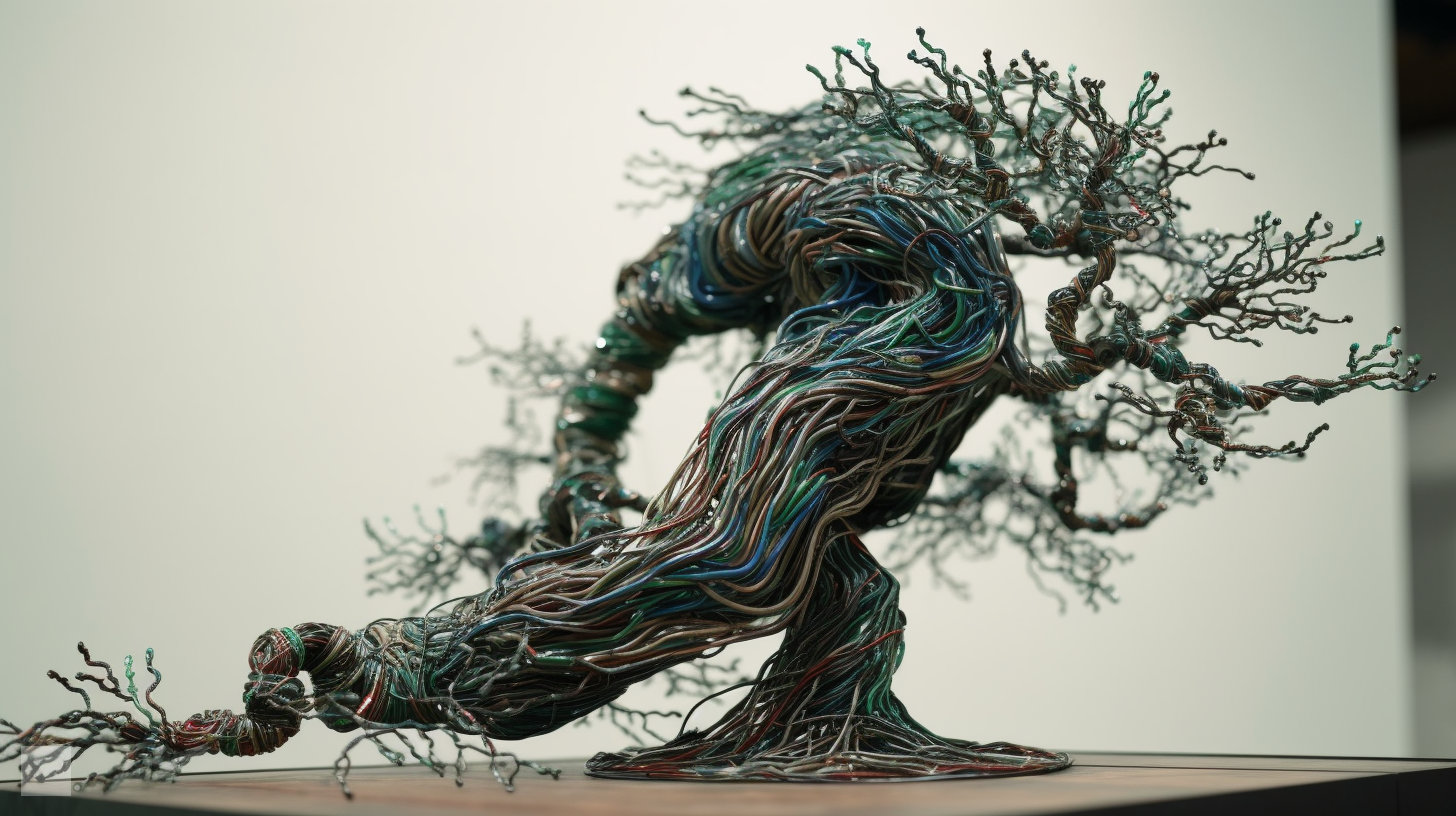
Yes, I do use generative AI tools in the stuff that I put on this website.
I have thought a lot about whether to continue doing this, and I might change my mind, because the reasons against are pretty compelling:
- Generative AI tools use models that have essentially stolen other people’s intellectual property, even if the legal system might not adequately recognise that. We all know it to be true.
- Beyond that, I believe that the most successful of these tools are being used by the worst people for the worst reasons: to monopolies culture and ideas and to exert abusive control over as many people as possible.

So what justification could possibly offset that?
Well, these tools are owned by the worst people… but they weren’t built by them. I believe it’s possible to use this technology add something to human knowledge and creativity.
Here is the video that crystallised my thoughts on this. It’s by tech journalist Becca Farsace, formerly at The Verge, in which she interviews a German artist called Boris Eldagsen.
He won a photography competition with generative AI art, but he used it to make a specific point.
These tools are here, and unavoidable, but they can be interesting.
They can be interesting because, if an artist puts in enough work And tweaks and tweaks and tweaks, it’s possible to create something that could not have been created any other way. And I agree with him that that’s an exciting idea.

However, he added some context which I believe to be essential.
He said we shouldn’t think of generative AI as a tool. It’s a whole other completely separate art form. It’s not photography, it’s not music, it’s not drawing, it’s not fictional essay writing. It’s something else.
It’s something new, but it’s also something in the spirit of postmodern art. It’s like the hip-hop and dance music of the 1980s and 90s that were exploring sampling other peoples work to make something new and important to comment on a communities body of work, as well as an individual artists.
And that’s why there is one more essential thing he suggests we need to do with AI art:
We must always label it as AI art.
If we know it was created by an AI model, he suggests (and I agree) that it can be interesting. But if you have any doubt whether an image is AI or not, that’s going to overshadow anything interesting the work might have to say.
So I am going to use generative AI art on this website, but there are two things I’m going to consistently try to do:
- I am going to try to find a models that have only been trained on works in the public domain. I think this will be tricky and will take time, but I’m hopeful this might be a possibility in future.
- I am going to clearly watermark everything I’ve made that is AI, if it isn’t added already by the AI tool. Now, I made some AI stuff before writing this, so I’m afraid that’s going to slip through the cracks, but from here on if I make music with generative AI components (which is a lot less likely) I will mention it in the track description. If, however, I use generative AI images or video (which is more likely) I will put a little square in the bottom left-hand corner where the brightness is altered slightly.
It will look a bit like this:

I don’t want it to be visually distracting, but I want it to be easy to find if you look for it.
I’ll finish by saying that I disagree with the big tech companies that AI is the future of art, and that the future of art is mere spectacle.
For me, Art is the exploration of philosophy through metaphor. In order to have a philosophy, you need to have had experience in the world, and have a point of view on it. And you need to care enough about other humans to share it. Without just wanting money or control.
I think it’s possible for AI to help in doing that. I don’t think it’s possible for AI, or AI companies, to do it all by themselves.
You must be logged in to post a comment.