
Yep. Happy Halloween.
October 2026

Okay, AI music is really good now
Let’s all have an existential crisis, shall we? I had already heard a bit of AI music. Not a huge amount, because it didn’t really interest me so I hadn’t gone looking for it. But I had heard parody songs of Rage Against the Machine as a 1970s Isaac Hayes record or whatever. Technically very impressive, but so what? Okay, to be fair, I was open to the possibility that I might one day hear some AI music that I genuinely thought had some kind of artistic merit… but I wasn’t holding my breath. Anyway, few weeks ago, I found it:
The music for this video was generated entirely in the AI music platform Suno, and the video was created by Claude. And…
You know how if you see anything on social media that is obviously made by AI the comments rip it to shreds? Well, the top comment for this YouTube video was: “Oh no, it’s a banger”. And all the other comments agreed.
This one is… good?!
I’ll give some context. The song is from the perspective of a software developer, who watches helpless as AI (specifically Claude Code) is introduced in the company she works at, and then basically takes it over from the inside. The developers’ jobs become simply clicking ‘approve’ when the bot writes forty thousand lines of code that no one will ever read, leaving the developers to just leave the comment ‘LGTM’: looks good to me.
The thing that struck me, as someone who has been writing and recording songs for over 35 years is just how accomplished this song and music video is. How detailed. How precise in the way its momentum is crafted.
I don’t think there is any specific aspect of it that I couldn’t make myself, given the time, budget and a team to work with. But if I’m honest, even with the time and budget and team, I don’t think I could create something this polished, because I don’t think I would get everything right. (Yes, too much polish is often boring in music, but this is an example of when it can really work.)
Now, as I’ve mentioned on here many times before, I backed away from making library music for film and TV because AI basically killed the business. Which sucked, obviously. But that was AI encroaching on my corporate music gig. It’s a different thing when it’s coming for the kind of songs you might actually want to write yourself.
So I could get angry about this. I could have a panic attack about this. I could march out to destroy the data centres and attack the Silicon Valley offices with flaming torches and pitchforks.
But the genie is sort of out of the bottle now. And it doesn’t look like sensible regulation is coming anytime soon.
What to do? Well, I’m going to get into it here, obviously, but first the other stuff…

Blog Post
THE OPEN INTERNET IS DEAD. GOOD.

Okay, another rambling blog post about the state of the internet, which I mainly wrote to help process my own thoughts.
But the TLDR is that censorship is bad, but I always thought the ‘Open Web’ was kind of overrated. Or at least misleading.
Recommended
‘WELCOME TO THE INTERNET’
So, I wrote in the above blog post about how maybe the Generation X idea of the open Internet was always doomed. Maybe its early years were gentler and safer because the big bad world didn’t understand it yet.
However, I recently stumbled upon this video again, from Bo Burnham’s hit Netflix series that felt like it defined the whole pandemic. Five years and 178 million views later.
The first thing that struck me is that, dystopian as this song is, it feels like it’s from a more innocent time – because it’s before AI.
But having gone back and listen to it many times (because it is spanking good songwriting) what strikes me now is how it seems to be capturing that moment when the Internet was transitioning from being a fun and exciting way to connect with people into the new place where power is exercised, and public good is corrupted for private gain.
But then, like I said in the above blog post, maybe this was just the inevitable end of a social experiment that was bound to fail eventually: the idea that you can create a space that is more equal and inclusive by getting rid of all the rules..
Recommended
TOM SCOTT ON AI (in 2023)
Maybe YouTube looked at my Watch History and saw I was succumbing to internet nostalgia, and decided to feed me this.
Tom Scott, the Internet’s one-man BBC Four documentary, made this video in 2023 just as ChatGPT was on the rise.
He predicted everything was going to change, and I think he called it pretty well.
Recommended
ANY HUMAN EVER
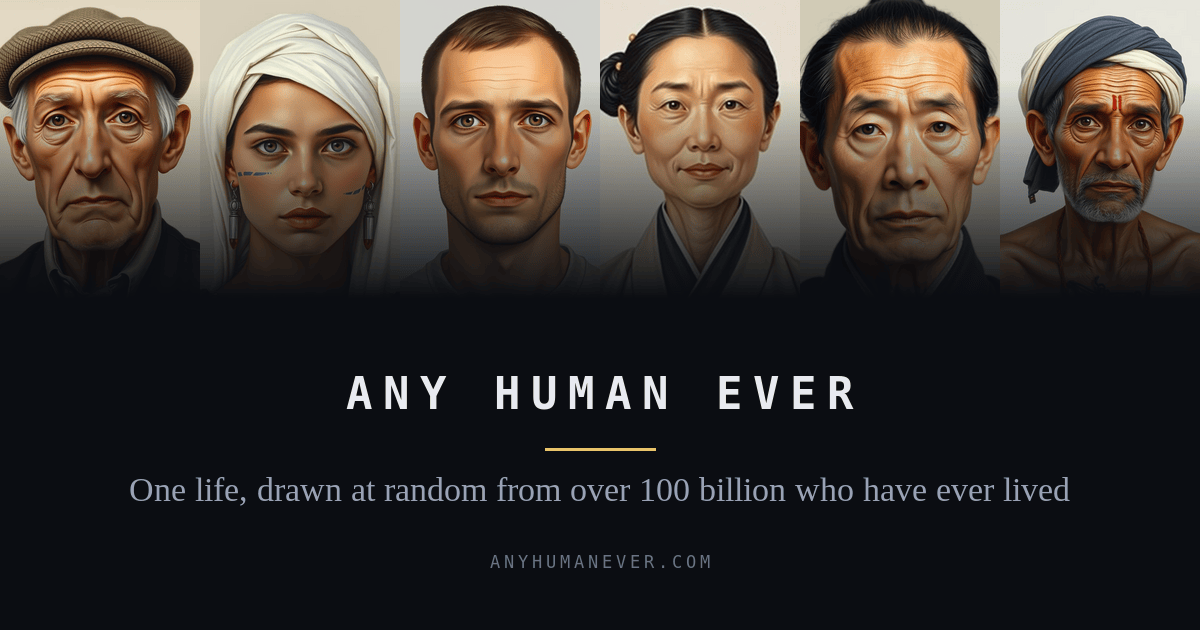
Okay, while we’re still in the AI vortex: H recommended this website to me as ‘the only good thing AI has ever produced’.
From what I can tell this website was vibe-coded by a mysterious anonymous person, and it allows you to press a button and draw a profile from one random person in history.
I’m actually just going to quote the website:
History, let’s face it, is a collection of stories. We walk around with a grab bag of anecdotes in our heads: Abraham Lincoln kept his papers in his top hat, Henry VIII’s leg smelled terrible, Vikings didn’t actually have horns on their helmets, and so on. For many of us, this set of stories is part factoid, part anecdote, and part moral arc.
But as a depiction of reality, it’s a statistician’s nightmare. The stories that we call history are a deeply biased sample, selected for a variety of reasons, none of them having to do with fairly representing our collective past. We know far more about the sequence of Frankish kings than we do about a typical peasant’s routine in 5th century Avignon. Think of your notion of history, and contrast it to the fact that most lives ever lived were Asian, poor, and brief. You knew that thing about the Vikings’ helmets, but how much could you say about the unrecorded 99% of past humanity?
I got a woman in China in 2100 BC. I think my life expectancy was 29 years of age.
It’s really fascinating, and well worth a look.
Recommended
‘TO LIVE AT ALL IS MIRACLE ENOUGH’
Let’s have a timeline cleanse, shall we? If there is a polar opposite to AI and everything it stands for, it is Edward Pope reading To Live at all is Miracle Enough at the Catweazle tribute event last week.
The poem that Ed Pope has read at every Catweazle anniversary since the dawn of time. The poem that my wife and I got Ed to read at our fucking wedding!
Machines, my friends. Machines are weaker than a beetle’s wing.

Upcoming Events
Friday 13th November


Dear Diary…

So yes. Last Saturday saw the big Catweazle tribute concert I have been plugging here for the last couple of months.
And it’s obviously the big thing to write about. But it also relates to AI music in an interesting way, I think – because a few performers alluded to how toxic the landscape has become for musicians and lovers of music alike.
And that makes Catweazle, which was absolutely the antithesis of that, all the more precious.

The night went about as well as we (organisers) could’ve hoped, and emotions seemed to be running high – in the best way possible.
However, I had volunteered to do the sound. (Yes, we broke with the Catweazle tradition of being unamplified – the venue was just too damn big, and it was a marquee, and there was a gale outside!)
And so I felt like the emotion actually passed over me somewhat, because I spent the evening trying to figure out why the second vocal mic was only coming out of the left speaker. We (well, Phoebe) managed to hire a great photographer who filmed the whole gig, and I’m looking forward to letting time pass and then sitting down and watching the whole thing properly. Sort of for the first time.

I’m still a bit gutted about all the artist we couldn’t include, such as Jessica Law, Wayland the storyteller, and especially Claire LeMaster. But that would have been my Catweazle – there have been so many generations of artists over the decades, and so many different Catweazles, I suppose.
But it was strange that I didn’t feel the expected wave of nostalgia seeing all these old friends I hadn’t seen for years. And I think that was because it just felt like a Catweazle event – so easy and familiar – and it felt like I last saw everyone about a week ago.

Something else I really noticed, particularly while doing the sound: it was a Catweazle event – a Catweazle tribute. It wasn’t Catweazle.
It wasn’t Catweazle because the room was too big. For me at least, it lacked two things that made Catweazle work. It lacked the focus of a dark room and a stage lit by spotlights, so that the only thing your eyes were drawn to was the performers. And yes, it lacked the famous unamplified sound. I could really feel how much of the difference that made, from when a whole room has to lean forward to hear every detail. When the loud applause and cheering can be contrasted with pretty intense moments of silence.

But it was supposed to be a tribute, not the original. We were there to celebrate its passing – that was the whole point.
And, like an idiot, I made a sort of ‘JFK commitment to land on the moon’ by saying there would be something that would fill the hole that Catweazle left. People asked me what I meant, and I had to admit I had no idea. But, as I said on stage, it’s too important to let die. Particularly now. Particularly as music feels under attack from every direction.

Anyway, here is my set. I went on first because, as you know, I am all about that tradition.
So What Have We Learnt?
So let’s get back to this existential crisis that I mentioned at the top.
I have already started looking into how to make music that contains AI ‘poisoning’ that it will damage any model that tries to train on it. But I hadn’t been planning on what to do when generative AI can do the kinds of things I want to do better than I can.
What are we supposed to do about this kind of encroachment on not just our professional lives but our self expression and identity?
One of the first things that occurred to me – that I think is going to be how I deal with this problem – is that old adage:
If you can’t beat them, join them. And then beat them.
I think I’m going to start making AI music. For one very particular reason.
I want to start experimenting with writing and recording my own music, and then seeing if I can prompt a generative AI model to do what I just did, but better. And if it can then I either have to go back and make my music better, or I have to ditch the idea and come up with something new entirely.
And actually, I find that idea rather exciting.
I’d still much rather these plagiarism machines didn’t exist, but they do right now, and if that means I have to work that much harder to come up with new ideas that have never been fed to the beast, maybe this might force me to make better music than I otherwise would’ve done.
I have already downloaded some software for doing this. When I get a moment, I might try prompting AI to rewrite some of my old songs that I’m happiest with, just to see what it does.
So, this is just what I have learned this month.
Let’s go back to that song that kicked this whole existential crisis of mine off: LGTM. Judging by this video, it wasn’t just some cute little idea a YouTube creator came up with. It seems like it was completely autobiographical. And the author created the music video, quickly, and sent it to their boss, who posted it on LinkedIn, where it went viral. And the whole of Tech LinkedIn started to talk about it.
And… what did they learn?
Well, nothing.

Ask me things

If you have any questions then seriously, do please leave a comment or drop me a message here. About life. About the universe. About what Catweazle 2.0 might look like. Because right now I don’t have a good answer, and I suppose I’ll have to think of one.
Photo Credits
- The photos and video from the Catweazle event were taken by Tyler Mobey (except the video of Ed Pope, by Laura Theis… I think?)
- For all the rest, please click on the images to see the originals. (It just means less admin for me this way.)
Leave a Reply