I don’t know why I feel any ambiguity about that: I’m contemplating signing up for the new subscription package to theverge.com and that’s pretty much the dictionary definition.
I fell in love with Apple products in the 90s, back when their help feature was so genuinely helpful that it would ‘manually’ circle the button or menu item that you needed in red.
I’ve written before (elsewhere) about how I love to discover what the absolutely most bleeding edge technology is, yet I only like using the most low-tech solutions in my actual life.
But since Trump’s re-election I have somehow lost all my mirth regarding bleeding edge tech. It’s a joke that isn’t funny anymore. I find it sort of distasteful, in a way that’s hard to articulate.
So, as a way to articulate it, I gave it a name.
But first, a little tangent.
Vichy France
Early in World War Two, when it became apparent that their military forces were about to be overwhelmed, the French government was divided about what to do next.
Should they move the government to North Africa and continue fighting the war? Or should they effectively surrender and collaborate with Nazi Germany?
The latter faction won, and for a few years (until Germany eventually invaded anyway) the new French government was an ‘independent’ puppet state. They weren’t ordered to embrace Nazi policies, but there were ultra-conservative factions in the ruling elite that had been there since before the first Revolution, and they had now taken power. So even though they weren’t taking orders from Germany, they might as well have been.
They moved the centre of power away from Paris to the resort of Vichy, and ‘Vichy France’ was born.
Vichy Tech
I’ve been looking for an analogy for how the Tech world seems to have changed since the Trump election, and this was the comparison that made sense for me.
On the surface, the re-election of Trump, after the insurrection, the criminal conviction, everything… it seemed to mark a huge shift. But now I’m wondering if things really changed that much, or if this is just the first clear visible indicator of what has been happening behind the scenes for years.
Watching so many powerful figures in the US, particularly the big tech companies, pledge support for Trump before he even won the election was revealing.
Companies like Apple, Google, Facebook, Amazon and Twitter were once quirky upstart outsiders, but over time they grown so successfully that they’ve become online empires. The phrase ‘walled garden’ gets banded around, but realistically ‘digital nation state’ fits more. These platforms have tried to become not just everyone’s town square but their news network, their workplace, their shopping centre, their cinema and arcade, as where as the place they keep all their important documents and photos of people that they care about.
There was a time when they provided these services so efficiently and conveniently that their dominance of our future seemed inevitable. Now they don’t even do that anymore.
And now whenever I see tech news about these companies, I feel like Captain Renault felt about Vichy water in Casablanca:
You know websites are still a thing, right?
It’s slightly embarrassing that it took the video below by (tech writer and scourge of Crypto Bros) Molly White, to state the obvious and make me realise (and I’m paraphrasing here): “You know that websites are still a thing, right? They still work! They didn’t go away because they became any less useful to us. They went away because they became less useful to Google, Meta, Apple and the rest.”
For years, the biggest reason why the old web—websites, RSS, email newsletters, blogs—was a pointless endeavour was because everyone else was on the new web of social media platforms.
Right now, those flocking back to the old web are likely to be very small in number. But if you’re someone who’s getting increasingly disgusted with Vichy Tech, those might well be your people!
And there might be one more significant factor in favour of Team Open Web. Once upon a time Google Search was so useful that it was essentially the front page of the internet. (Sorry, Reddit – it was never you.)
That’s a post from Bluesky, the app which basically rebuilt Twitter on the principles of the open web. It allows links! It allows a reverse chronological feed of the people you actually follow! Websites are back, baby!
And Hank Green summed it up in a Bluesky post when he said:
“Spending a month on Bluesky has created a whole new model of a fight we need to be having right now. Not liberal vs. conservative or whatever, but respect vs manipulation. I am tired of being manipulated everywhere I go. That’s why I like it here, I feel like I’m in charge for once.”
I think this is the beginning of a beautiful friendgroup.
So the Catweazle Club has returned in a new venue, which I really like. (See above.) I was able to make it to the opening (although parenthood means I’m unlikely to be able to come to others for a while). But only as a spectator.
As I was watching, I was thinking about what songs I might perform when I actually get the chance to. Which of my songs would work in this new setting?
And I had a bit of a mini existential crisis, as I realised that none of them really would.
But it was weeks after that I realised I’d forgotten something important.
Catweazle was always one of two regular music events that formed the centre of my social and artistic world. It was where I went to catch up with old friends, but it was also where I went to regularly perform.
But I had a formula, and that formula wasn’t really about the songs that I wrote myself.
What I would do was get there really early and join the performers queue before anyone else. I would sometimes be first, sometimes second, occasionally third, very occasionally fourth. I would get a seat right at the front. And then, usually, Matt (Sage – ‘Mr Catweazle’) would put me on as the first act. Performers get two songs, or around 10 minutes (if not music), unless it was a very busy night when we’d get half that.
So I would start the evening off with a high energy cover of a well known pop song. I became well-known for it. And over the years I came to believe that it would actually influence the whole night, because it would establish to the artists who came on after me that you’re allowed to be loud, go big, show your emotions, be a bit extra. And you didn’t need to worry about looking foolish and ridiculous, because the first act was some bald bloke who just tried to sing Wuthering Heights in the original key.
Then, if I got a second song, I would play a traditional English folk song. And this could influence the evening too: having established that it was okay to look ridiculous I wanted to establish that this was a space where it was also okay to be a bit more thoughtful and sincere, even if that was sometimes in danger of being a bit pretentious.
Once I’d finished my two songs, I’d sit in the front row, and… er… try to work the crowd.
I’m not sure if I pissed Matt off doing this – I hope not. He must have gathered (over the decade and a half of me going) that it was a deliberate strategy on my part.
Here’s what I would do:
There is a natural gap between when a performer finishes their act and when the audience applauds. And we’re all social animals, and we take our cues from each other. At pretty much every other open mic night I’ve been to the applause starts off underwhelming, because no one wants to seem too keen. And it might build if everyone really enjoyed the act – or it might fizzle out, even if everyone did enjoy it!
So, after every act (unless they were actively cruel or abusive), I would applaud, and often cheer or whoop, as soon as possible in that gap. Loudly. I would broadcast “well, I think that was great, no matter what anyone else thinks”. Again, establishing to the room that there’s at least one person who is happy to be a bit extra.
If you noticed me doing it over and over then I could imagine it might have got irritating. But it had a cumulative effect through the night. The room got into the habit of applauding, early and loudly, and that had an effect on the performers. They tended to get more hyped, and up their game.
Now, Catweazle had been an extremely welcoming space in the decade before I started going. But I was consciously working the room every night I went from pretty early on. For a few years I went literally every week. Then for a few I would go every fortnight.
I made it my mission, basically, to make the night as amazing as possible.
And so when the time came for me to start my own regular music night, the Bastard English Session, I took that formula that I’d developed from Catweazle and based the whole night around it.
This was an event for which I never played my own material: it was either Trad or it was Pop (usually in that order).
These two styles of music – Traditional Folk and well-known Pop – have always gone together with me. Perhaps because the folk music I’m drawn to is really just old popular music.
I always liked the idea there might one day be other types of ‘Bastard’ Session: Irish, Breton, etc. But I realised that getting that very particular Bastard energy does require a very particular MC.
Specifically, someone who can Bring The Pop.
So why is Pop so important? To me and, I would argue, to most people?
Because there is this unifying power in shared musical references.
Noel Coward once famously wrote: ‘It’s extraordinary how potent cheap music is.’ And he was, of course, a snob, but I do think that music which we consider to be ‘cheap’ does have a tendency on creeping up on us, emotionally.
When a bunch of strangers and semi-strangers find themselves singing along with a pop song that they never realised they really liked, the energy in that space goes through the roof. If it’s a folk song, you know that you’re taking part in a tradition. If it’s Teenaged Dirtbag then it’s really just about sharing joy.
Anyway…
All of this to say that I’ve realised that for the last 15 years or so I’ve been writing songs, but I haven’t really been performing them. Because, I realise, that’s not the job I’ve given myself.
It’s partly to be the one who explores the tradition. But it’s maybe mainly to be the one who brings the pop.
Out of frustration at how the gradual enshittification of Facebook Groups was destroying my ability to organise folk music events, I created a Discord server called ‘Bad Tradition’.
A few friends then got in touch with me and asked if I could explain how to use Discord, so I thought I’d put it in a blog post.
Discord.com is a web platform that lets users chat with each other in separate organised ‘channels’. It was originally created as a place for gamers to coordinate online game strategies, but as it has grown and grown in popularity it has become a more general place to chat for any online community.
It’s a bit like a cross between a web forum and the way Facebook Groups used to work. If you’ve used Slack or Microsoft Teams, it’s like that, but for hobbies instead of business.
Yeah, I mean, that’s fair. The 2010s were kind of an old fashioned ‘rise and fall’ morality tale for a number of the biggest social media apps.
But they got big and powerful for a reason: the ability to communicate with your friends and family remotely at any time is one of the great gifts of the 21st century.
It is getting harder and harder to do though, and I think it’s this decline that has led a lot of people (particularly younger people) to Discord.
So what are the advantages?
Here are what I consider to be some of the biggest advantages of using Discord over, say, Instagram, Twitter (are we really going to keep calling it ‘X’?) or Facebook:
No ads, no spam, no constant confusing new features added (and then suddenly removed)
No algorithm designed to boost outrage and anxiety and keep you hooked
It is literally just a real-time feed of posts made by people that you actually know
But it also has a basic level of organisation: it’s not just one mega-thread where the conversation and focus keeps changing every second
I’ve been saying for years that the best social media platform is Facebook circa around 2008 (before they’d figured out how to optimise for engagement with negative emotion). And Discord right now is actually pretty close to that design.
I’ve also been saying that ‘social media’ today isn’t really social. It’s just ‘media’. It’s huge, algorithm-based, and full of people you will never meet.
And messaging apps like WhatsApp (which I find deeply clunky to use) are for keeping in touch with people who you already know.
Discord seems to be where new communities are built. Discord is where you can meet and get to know new friends online, who might be interested in the same things as you.
And the disadvantages?
It’s still funded by venture capital, so it’s presumably not immune to the forces of Enshittification (although at least it seems to be profitable already, so those investors won’t panic in 5 years and break everything)
Whilst it doesn’t have the scale of problems with trolling, doxing and shitposting that other platforms have, they are still a problem
It has a user interface that makes Facebook circa 2008 look like some kind of clean, exciting, cutting-edge design
And, of course, it’s one more fucking app on your phone
Whilst you can ‘friend’ and send direct messages to people, it’s really a place for group chats that are structured into different topics.
These group chats (rather confusingly called ‘servers’) can include just a handful of people or they can be thousands.
Within each chat there are separate feeds divided by topic, and within them you can post text, photos or (very short) audio or video. You can reply to people specifically, and you can add all sorts of emojis. Too many emojis, some might say (although not me because I’m extra).
And there’s a bunch of other features that we try to avoid on Bad Tradition because life is complicated enough. But they exist too.
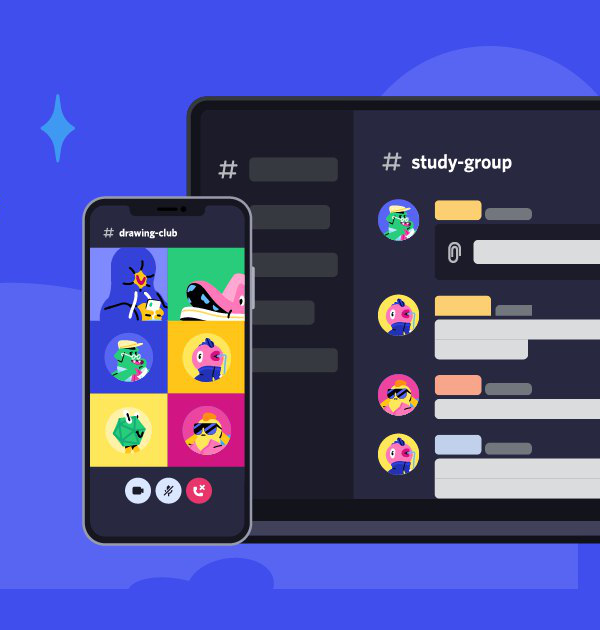
Here’s how Discord looks:
There are two sidebars on the left, and then a main window – much like most email apps. So (in emails) you might the Inbox on the far left, and then see a list of the most recent emails in the Inbox, and then in the main window it will show the email selected.
In Discord, on the far left, there’s a sidebar that lists all the servers (i.e. group chats) that you’ve joined. These servers are displayed as circular icons.
In the middle sidebar there’s a list of topics (that start with a #) that the group chats are divided into.
And if you click on any one of these # topics the main window will show you that topic’s feed.
Why does it look so…?
Yeah, you’re probably going to want to go to User Settings > Appearance.
I immediately set it to Dark Mode, and increased the font size. There might be other things I tweak over time too.
And that is probably a sensible choice for most people. Our digital lives are already full of so much clutter.
But I think it’s worth being aware of what the options are.
And if you miss the days when social media was actually social, and therefore fun, and you are part of a community that is gradually getting pushed out of online spaces…
It’s worth remembering that Discord might be a solution.
Since George Lucas sold Lucasfilm to Disney and Kathleen Kennedy took over… they’ve actually been doing a really good job.
Come at me.
There are whole YouTube channels dedicated to trashing Kennedy and/or ‘woke Disney’, but here’s my thesis:
The Fanbase Scaling Problem
I think Star Wars is the first entertainment franchise (in the West at least) to have a fanbase so large that it is totally impossible to please everybody.
Is that hyperbole? Really? The first? Not Star Trek? James Bond? Sherlock Holmes? Shakespeare’s plays featuring Henry V?
Yeah, these were all very popular, but then along came the internet.
George Lucas
And I think Star Wars creator George Lucas got caught out by this. I think he assumed that his returning after 20 years to make 3 prequels to his much loved trilogy would be met by excitement by the next generation of his target audience – 11 year old boys – and that the older fans of the originals would also be able to enjoy a little gentle nostalgia.
What he didn’t realise was that the older fans assumed he was doing it for them.
And their initial excitement turned to rage when they realised that the child-centric tone of the originals hadn’t been some accident, or a cynical way to sell toys, but was actually part of the creator’s vision. And they directed their rage, online, to the movie’s actors – Ahmed Best and Jake Lloyd – in a pattern of bullying that would continue to this day.
At the same time, however, the younger audience that George Lucas was hoping to target with the prequels, and then later with a run of Star Wars cartoons for TV, did actually grow up loving the franchise and claiming it as their own.
And to complicate matters even more, there was also a generation of Star Wars fans my age who saw the original films in the cinema and became obsessed with them, and who actually did appreciate the prequels and cartoons in the affectionately nostalgic way that George Lucas hoped.
Basically, the Star Wars franchise developed a fanbase with factions. But it was also a fanbase so big (and, thanks to the internet, so connected) that it was able to make George Lucas feel its anger.
Star Wars wars
In the Tested podcast, Norman Chan once outlined the 6 Stages of Fandom:
I love this
I own this
I control this
I… can’t control this!
I hate this!
I WILL DESTROY THIS!
As other huge media franchises followed Star Wars, this factional battle played out over and over again, but I think it happened with Star Wars first: different segments of the audience want different things, but certain factions are louder and angrier and more aggressive than others.
Eventually I think George Lucas just had enough of this, and he sold Lucasfilm to Disney, who he felt would understand that this was a franchise whose purpose was to give young people hope (and not to make 28 year old neck-beards feel like a badass).
Kathleen Kennedy took over Lucasfilm, and – after a few tentative projects – she tasked J J Abrams with the job of basically placating the angry faction and giving them exactly what they wanted: which he did with The Force Awakens and The Rise of Skywalker.
J J Abrams and Kathleen Kennedy
These films were absolutely not for me. But I don’t blame Kennedy and Abrams for that. Not every project is for me, and that’s fine. I bitterly oppose the way in which many in the Angry Faction bully people online, but I think it’s a good thing that they’ve got movies that speak to them specifically. (And now they have a TV series, Andor, which seems to have done that even better – whilst keeping the rest of the fans happy too, which is nothing short of miraculous!)
Since Kennedy has taken over, every project usually gets the same criticism: it is merely ‘fine’. (Even the projects that the loudest fans love – The Mandalorian and Andor – receive this criticism, often for wildly varying reasons.)
But my thesis is that it takes extraordinary levels of skill and diplomacy to even get to just ‘fine’ with a fanbase this divided. I think Lucasfilm have recently done really well at delivering consistent entertainment that doesn’t break the universe.
They even made some for me
But first, a little backstory.
So there was a point, around the release of The Force Awakens, when it seemed to me that the loudest fans felt like the biggest problem in Star Wars… was George Lucas. They felt betrayed by him, and that he didn’t really understand what Star Wars was actually about. He had fluked a masterpiece, and now he should leave it to his fans (like J J Abrams) to continue it in a mature way.
And not too long ago I was thinking about this low point for Lucas, and wondering why he didn’t just make some kind of really small scale Star Wars project that none of the noisy fans would care about, so he could carry on making space wizard fantasy for 11 year olds.
And then I remembered.. he did. It was called The Clone Wars.
Saturday morning cartoons
The Clone Wars was a theatrical movie, but it was also a cartoon, telling a story about events between the prequels and the original trilogy.
And although Lucas oversaw it, he did something he seems to be pretty good at doing: he delegated. In particular, he picked a young animator called Dave Filoni to direct it. Filoni came back to oversee a whole TV series spin off of The Clone Wars, and over time a sort of ‘master and apprentice’ relationship developed with Lucas and Filoni.
Put a pin in that, as they say, as we’ll come back to it.
Much like the prequels, I wasn’t expecting to like the animated movie, but when I saw it I was reminded why I fell in love with Star Wars as a child in the first place.
It is corny, it is child-centric, and it doesn’t bear much relationship to the science of the real world (e.g. every planet seems to have a breathable atmosphere, and pretty much every alien is humanoid.)
In fact, it always feels like those old Flash Gordon series of the 1930s – with the epic classical music, opening crawl and “Boy am I glad to see you!” dialogue. Which I was always on board with, as I remember seeing those 30s reels repeated on TV on Saturday mornings when I was a child (yes, I am that old) alongside children’s cartoons.
But, underneath that Flash Gordon pastiche, the storytelling is masterful and always has a point to it. Everyone who knows a little about George Lucas knows how he was the best known disciple of Joseph Campbell and his book The Hero With A Thousand Faces. Less well known is Lucas sees Star Wars more as ‘anthropology fiction’ than ‘science fiction’, and I love the clear care that goes into his world-building.
Lucasfilm 2.0
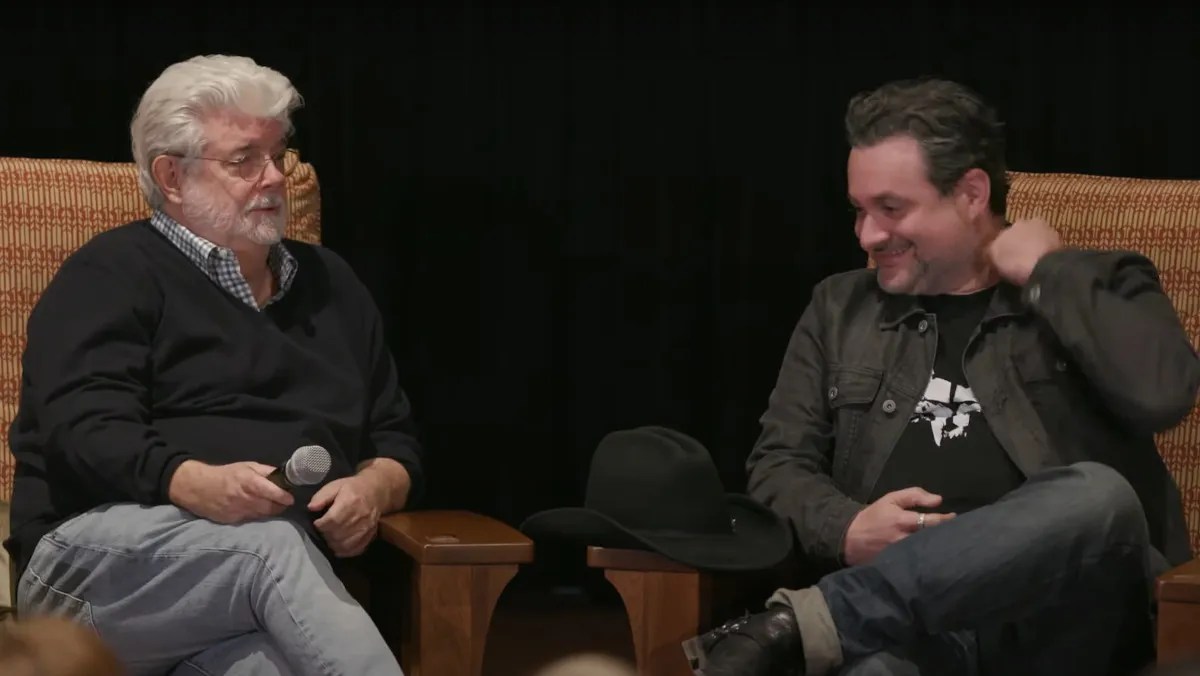
George Lucas and Dave Filoni
Lucas and Filoni quietly carried on making new Star Wars stories for a younger audience for years, following Star Wars: The Clone Wars with Star Wars: Rebels, and then Star Wars: Resistance.
In 2012, however, Lucas sold the (then independent) Lucasfilm to Disney, and Kathleen Kennedy took over as CEO. And the heir apparent to the role of creative director appeared to be not Dave Filoni but J J Abrams, fresh off his recent Star Trek reboot. But the movies made during his era divided fans: some loved his refocusing away from Lucas’s prequels to the original films. Some, like me, felt they lacked the storytelling and world-building elements that made Lucas’s films so great.
But then along came The Mandalorian, and everything changed.
The Mandalorian
This was a live action TV series, directly influenced by the films of Sergio Leone and Akira Kurosawa (who were such an influence on the original Star Wars films), featuring a masked bounty hunter tasked with protecting a child.
And it was also the flagship show for the the Disney company’s vision of the future: a streaming service called Disney+. If The Mandalorian was a huge hit, Disney+ could get a huge number of subscribers who were unlikely to be bothered to unsubscribe, given access to all of Disney’s vast video catalogue. If The Mandalorian was a flop, or even a moderate success, Disney+ might not get over that initial subscriber hurdle and might fail, leaving Netflix as the only serious streaming platform in town.
Jon Favreau
So Disney pulled out all the stops, getting director and actor Jon Favreau to hopefully repeat the magic trick he pulled when kickstarting the Marvel Cinematic Universe with Iron Man back in 2008.
And this was really where the new era of Star Wars found its footing.
Favreau basically formed a partnership with Dave Filoni, and together they mapped about a new Star Wars cinematic universe… except it wasn’t for cinema: it was for streaming television.
And The Mandalorian was a hit. A huge hit. Enough to make Disney+ one of the biggest streaming contenders. Enough to give Favreau and Filoni a license to do… pretty much whatever they wanted. Enough to even (whisper it if you dare) unite the fans. (As much as that’s even possible these days.)
The post-Lucas era to that point had been pretty chaotic, with unconnected movies coming out here and there.
But now there seemed to be a plan.
A TV franchise with 4 showrunners
Apparently there are still movies planned, but the focus recently has been TV series (understandably, given the pandemic meant no one was going to cinemas).
And they seem to be run by this very interesting division of labour, who, for now at least, all seem to be on the same page:
George Lucas as Founder, Kathleen Kennedy as CEO, Jon Favreau as Showrunner and Dave Filoni as Head Writer (and all-round Star Wars encyclopaedia).
And the plan now seems to be to focus each TV series on a single character: Din Djarin (the eponymous Mandalorian), Boba Fett, Obi Wan Kenobi, Cassian Andor…
And now the latest, which I’ve been looking forward to the most: Ahsoka Tano.
What’s different about Ahsoka
There has been a lot of talk recently about ‘franchise fatigue’. Understandably.
Marvel showed that it was possible to be the biggest thing in global entertainment by releasing a large number of films with interconnected stories.
But that becomes hard to sustain, particularly when your fanbase gets to big that large opposing factions arise.
And here we come back to my initial thesis: the problem of fanbase scaling.
Eventually the tension between the Nostalgia and the Anti-Nostalgia camps becomes so strong that it defines the whole franchise, and output see-saws from pleasing one to pleasing the other.
But I think this new series, Ahsoka, might have been that.
Not because it’s universally loved: it isn’t. (Or it isn’t right now at least.) Not because it’s a smash hit: it’s a moderate hit at best.
But because it doesn’t have to appeal to either the Nostalgia or the Anti-Nostalgia camp.
Because it’s Dave Filoni’s baby, and the first of the new run of live action Disney+ series that’s picking up directly from his Clone Wars and Rebels cartoons. The events are set in that world, and carry on directly from the end of Rebels.
So the loud and angry fans can’t dismiss this series as yet another betrayal of the fans by George Lucas or Kathleen Kennedy, because there is now a huge new generation of fans who grew up with Filoni’s cartoons. And they can’t claim that Filoni doesn’t really understand Star Wars because he was mentored by George Lucas for decades. And he clearly loves it, and knows more about it than perhaps anyone other than Lucas himself.
Basically, George Lucas did that thing that seemed like a smart move to me: make a side project that does exactly what you want it to do, and just keep it under the radar. Until it becomes big enough that it’s immune to Gen X fan rage.
So is this new Ahsoka world the future of Star Wars?
I certainly hope not, and I don’t think so. Because the only way to manage the Fanbase Scaling problem is to recognise no project will please everybody. The Rise of Skywalker thread of Star Wars bores me, but I hope they make more of it, because other people love it and it’s not all about me and my tastes.
But what I’m hoping Ahsoka does prove is that Star Wars can beat that franchise fatigue.
Because it now has this one channel where it focus on telling new stories. As well as giving Nostalgia and Anti-Nostalgia fans what they want in separate projects.
What is the Ahsoka series about?
She was introduced right at the beginning of the first Clone Wars movie, and has been Filoni’s central character (pretty much) ever since. In fact, she’s probably the character who has had the most screen time – from a gifted but kind of brattish child into a disillusioned adult to a classic Ronin warrior. I think it’s fair to say fans know more about her than anyone else.
In terms of Star Wars entertainment, I felt the series overdelivered.
But I did initially get the sense that, unlike Lucas, Filoni didn’t have anything bigger to say. He was just good at the Star Wars vibe.
I was very happy to be proven wrong.
Towards the end, all the loose ends were tied up in a single speech, which made it clear what Filoni believes Star Wars is fundamentally about.
And I love it!
[Spoilers ahead]
Ahsoka takes on an apprentice called Sabine, who proves to be pretty useless throughout the series. Everything she does undoes Ahsoka’s efforts, and helps the villains. And Ahsoka seems non-plussed – although nowhere near as non-plussed as I would be, frankly.
Sabine ends up giving the enemies the plans and then gets captured, while Ahsoka gets defeated, nearly dies, and has one of those great near-death dream sequences. (I’m going to call it a dream sequence although super-fans may rightly take issue with that.)
In which she meets, and then fights, her former master Anakin.
It was a great sequence, and it looks gorgeous, but I wasn’t sure what the point was – other than to get the fans excited by the return of an actor from the prequel movies.
But when Ashoka finally rescues Sabine, and Sabine says words to the effect of “you’re pretty pissed off with me, right?”, Ahsoka has this to say (and yes I’m paraphrasing).
“Here’s the thing. My master, Anakin, turned into Darth Vader – the Devil’s right hand man, essentially. And that left me a little traumatised. And I’ve been wrestling with that for a while, but here is what I realised: before that, when he was my master, he was a really good master. He stuck up for me again and again, often when no one else would. And he never abandoned me. Like I’ve abandoned you, time and time again. (And since your whole family was killed, abandonment is understandably a bit of a sore point for you!) So how about this: I will never abandon you again.”
And from that point on, Sabine goes from making all the wrong choices to all the right ones.
This is why I love this series so much, because it has condensed all of Star Wars into one central theme: mentorship.
Masters and Apprentices
And when you look back at all of Lucas’s projects, mentorship is also right at the heart of them.
These stories seem to me to be fundamentally about how we thrive with good mentors, and how we struggle and fail without them. And also how hard it is to be a good mentor, and how little mistakes can add up.
And yes, this is why, as a dad in my late 40s, I have so much time for this franchise.
Who else in entertainment (apart from Bluey) really cares about this stuff?
Yeah, so, it’s been a while. About five years to be exact.
In 2018 I had a lot of things going on, but I’d also seen the writing on the wall: blogs were dead. I wasn’t sure then what would replace them, but it seemed they were going the way of all things.
A few years later I also stopped doing my regular monthly newsletter, but earlier this year I started again because I just missed it. I found it a really useful way to just mark the time!
And I’ve also missed the blog format too. And in the intervening years (a) I’ve stopped caring about whether a format is popular or not, (b) I’ve learned why blogs really died and (c) I’ve got the sense that a lot of web history is going backwards. The seemingly unassailable giants like Facebook, Twitter and even Google now seem… well, assailable.
The impression I get (mainly from listening to The Verge’s podcast) is that blogs didn’t die because ‘technology moved on’. In fact, that’s generally not what happens. It’s because one tech company figures out a business model that turns them into a mega-corporation, and every other company in that space copies them. Even though it quickly makes everything worse.
So I always assumed that it was the mobile phone that killed blogs. ‘No one wanted to read that much text on such a small screen.’ But of course that isn’t true: people read text on phones all the time. TikTok may be extremely popular, but it’s not the only thing that people use their phones for. There’s emails, messaging, web searches…
No, it was apparently Google figuring out how to use Search to become the largest advertising agency in the world. And because Google Search became essentially the front door to the Internet, everyone had to be high in its rankings or they might as well not be online at all. So companies learned what Google ranked, and then gamed the system, to the point where useful websites got drowned out by spamfest listicles. You want to buy a printer? Good luck googling that and wading through pages of results like “10 Ten Printers In 2023” at www.[printer company].com.
And then regulations like the EU’s GDPR stepped in to stop Google and others from amassing vast troves of data by tracing your every move on the internet… and it got even worse. Now you needed to immediately ‘accept cookies’ to be able to read your spam listicles. Or you needed to go behind a paywall.
It wasn’t just Google. Apple figured out how to use its App Store to become the most profitable software store in the world: by charging every app developer 30% of their revenue. While Google was just bad at tending to the website ecosystem, Apple was actively hostile to it: trying to get everything off websites and into apps.
Then Facebook broke democracy and said “It was broken when we found it!” Twitter got bought by Elon Musk, and then started sinking. Then the founder of Reddit caused a mutiny, eventually referring to the huge force of volunteer moderators as ‘landed gentry’ and threatening to have them removed.
Now even Google Search looks under threat, with the possibility that online searching will get answered by chatbots rather than point you to actual sources.
And…
Well, I don’t know. I just get this hunch that maybe humble websites are making a comeback.
That’s not quite the whole story of why I’m back though.
A few weeks ago, this website completely fell over. I got told to update the PHP, and doing so broke it so completely that I couldn’t get into the back end without professional help.
And that made me really wonder what this website was actually doing.
So yesterday I went in and had a good thorough plug-in clear out. There was so much bloat and clutter in there.
Then I went and found a free WordPress theme, and just tidied things up a bit.
And now I have this much simpler website that I no longer find faintly subconsciously terrifying. And the thought of chucking occasional thoughts here is really pretty appealing.
There is no gatekeepers.
And, to be fair, no audience – but when has that ever stopped me?
I’m… sadly going to be putting the website on a bit of a hiatus at the end of the year. I’m not going to be adding new music or new articles for a while.
Partly it’s a combination of a career change plus ill health for a number of months, but I think I actually would have ended up coming to the same decision at some point anyway.











You must be logged in to post a comment.