Category: Blog

  • The Strings That Tie To You

    The Strings That Tie To You

    Have you ever stumbled on a song you haven’t heard in years, maybe decades, that used to be central part of your emotional world? Have you ever found yourself listening and thinking: ‘Wait! I know this. God, I remember this song – I forgot this even existed’? And then you’re pulled back into all the images and sensations of that time?

    That happened to me this morning with the song Strings That Tie To You by Jon Brion, from the soundtrack to Eternal Sunshine of the Spotless Mind.

    I wanted some background music I hadn’t heard a million times, and chose that soundtrack – which I often listen to, but clearly not all the way through. Because I probably haven’t heard this song in a decade and a half.

    Listening to it, for some reason, just made me feel incredibly old.

    It’s a film from 20 years ago, so should that be a surprise? Well, not every old piece of art makes me feel old. I remember seeing Return of the Jedi in the cinema, but that film doesn’t make me feel old. So I started to try to pick a part why Strings That Tie To You particularly did.

    And I realised that, listening to the soundtrack, I could remember this exhilarating feeling at the time the film came out… that this was the future, and it was great.

    Here was an example of the talent that was going to shape movies and music and culture in the future.

    Remembering this film makes me feel old, because that didn’t happen. The talented people behind this film either faded into the cultural background or became rich and successful in a way that eroded their liability and relatability.

    This film just became a blip, not a trend.

    This is one of the harder parts of aging that I experience all the time, I think: seeing talented people with huge potential have just a fleeting moment before it fizzles into nothing.

    And it would be easy to follow this down a nihilistic rabbit hole, and conclude that everything is pointless and doomed to failure. I do not believe that to be the case.

    But I have been thinking today about how to process this in a constructive way.

    And the conclusion that I’ve come to is that it’s on each of us, individually and collectively, to hold onto those fleeting moments of beauty that are created by talented people, or just created by moments in time. It’s up to us to hold onto them, and to use them to inspire us to make more beautiful things.

    We need to keep trying to push new flowers up through the layer of ash and decay.

    It’s ironic that this song that triggered this whole process was a song about dealing with painful memories that itself with soundtrack to a film about painful memories.

    From the wrinkles on my forehead / to the mud upon my shoe / everything’s a memory / with strings that tie to you.

    And particularly:

    And though a change has taken place and I no longer do adore her / Still every godforsaken place is always just around the corner.

    I mean, I realise that I have rewritten this song 100 times myself!

    But maybe that’s not a bad thing.

    We just got to keep pushing the flowers through the ash.
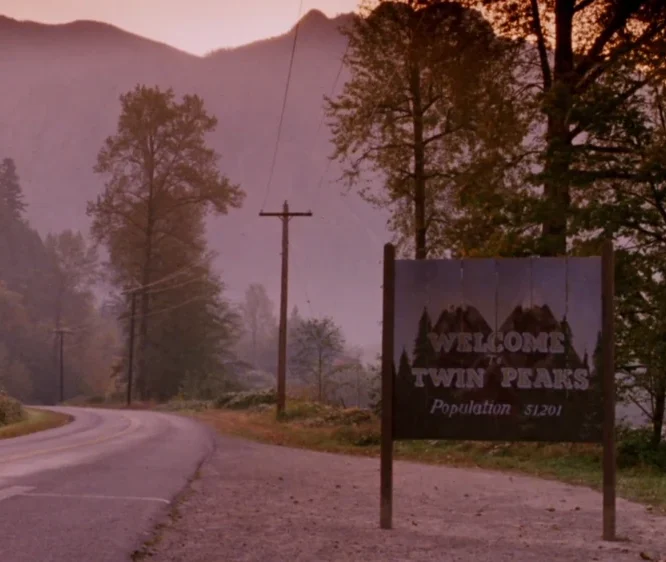
    Photo by Marta S. on Unsplash

  • A twisted love letter to David Lynch (1946-2025)

    A twisted love letter to David Lynch (1946-2025)

    “I’ll send you a love letter… straight from my heart, fucker!!” (Blue Velvet, 1986)

    David Lynch passed away on 15th January.

    I saw his Dune when I was 11 or 12, so I’ve been aware of his work most of my life. I probably first saw Blue Velvet in my teens, and found it weird and intriguing and messed up, but felt it was probably too old for me. When I saw The Elephant Man, I probably didn’t even realise that was a David Lynch film.

    And I remember watching Twin Peaks when it first aired on TV, but again I felt it was a bit old for me. I think it was when I came to watch it many years later that I really fell in love with all things David Lynch, to the point where he was probably my favourite filmmaker. No one else was as weird and imaginative and twisted. And yet, gentle and kind.

    This, more than anything, was what I (and doubtless many others) loved about his world. His villains were truly terrifying, but his heroes had a goodness and a kindness and an empathy that felt not only heartfelt but realistic. And my memory of that moment in movie and TV culture, no one else seemed to be interested in exploring the idea of Goodness.

    Perhaps my favourite film of his is The Straight Story, and this scene perfectly catches the aesthetic I grew to love.

    “The sky is sure full of stars tonight.” (The Straight Story, 1999)

    In fact, it was only after he died that I realised so many of the components of my own artistic aesthetic I ‘borrowed’ wholesale from David Lynch.

    But at some point in the 2010s I started to lose interest in his films. I hated Inland Empire, which I felt was overlong and incoherent, even though it had some great ideas. Had it been a series of 15 minute episodes, I might have loved it, but it wasn’t.

    And also, my attention started to move to the films of Hayao Miyazaki, who seemed to be interested in many of the same things but took them in other directions.

    But there was something else.

    Lynch had a knack for twisted erotica. No mainstream Hollywood director (and he was a mainstream Hollywood director) could do dark and sexy like he could.

    But as the 90s love of pulp fiction met the #MeToo movement, films like Blue Velvet, Lost Highway and Mulholland Drive started to feel exploitative to me. Was he just another male director playing with his beautiful actress sex dolls? There was something faintly Weinstein about the tone of those films.

    Well, it was heartening to learn after he died that both Isabella Rossini and Patricia Arquette were on record talking about how he created a collaborative, supportive and consensual work environment.

    And I would love to leave it there.

    But the recent revelations about Neil Gaiman give me pause.

    I stumbled onto this voice interview of Lynch, talking about his favourite film by one of his favourite directors: Stanley Kubrick’s Lolita.

    Many years ago I might have said “That’s an overreaction, surely. Kubrick is an iconic filmmaker and Lolita is one of his most celebrated films. It’s possible to greatly appreciate the film without condoning the behaviour of its protagonist!” (Which his grooming a minor, let’s be clear.)

    These days, however, I find it’s more useful to trust my instincts. And something about the way he talks about Humbert Humbert just feels… off, in a way I can’t quite articulate.

    I hope he didn’t have any dark secrets. I hope he was more Agent Cooper than Frank.

    I don’t know. I’ve learnt to give up on all my heroes, one by one. But not the beauty they produce. Kindness is kindness and empathy is empathy, even if it’s authors, like the rest of us, aren’t always perfect at maintaining that.

    And he was really good at empathy.

    For me, this is all of his traits wrapped up in one scene. Despite the world finally realising the kind and gentle soul he is, Joseph Merrick decides he will finally sleep “like a normal person”—knowing that, with his condition, this will kill him.

    Going to sleep for the last time. (The Elephant Man, 1980)

    “The sky is sure full of stars tonight.”

  • The Importance of Stuff

    The Importance of Stuff

    Photo by Toastt21 (CC BY-SA 4.0)

    We all have too much stuff in our lives, right? Material attachments. Clutter.

    There’s a whole corner of the internet dedicated to selling you a fantasy of living a truly minimalist life, without all kinds of shit on your walls or in your cupboards and drawers.

    In my teens and twenties I became obsessed with a kind of Westernised Buddhism, and I tried to detach myself from needing physical things like these. Actually, now that I think about it, to moderate success, because I didn’t become someone motivated by the desire to constantly own more things.

    But as I’ve got older I’ve realised that, whilst ‘material detachment’ still has its merits, it’s a big mistake to dismiss the objects we hold on to as clutter. The stuff around us, particularly in our homes, becomes part of who we are in a way that’s hard to articulate.

    Unfortunately, for some people, tragedy brings this importance into laser-sharp focus.

    If you’ve been on social media recently it’s been hard to miss TikToks of Palestinians finding their neighbours reduced to ash. (Although for many the loss of home and possessions is diminished by the loss of loved ones.)

    On a less brutal (but still pretty brutal) scale, for YouTube junkies such as myself, the Los Angeles fires have shown us in real time what it’s like for creators we’ve been following for years to lose everything.

    Van (brother of Casey) Neistat made this great video about how the fire nearly claimed his home and his work studio:

    In it he alludes to two other YouTubers who did lose their homes in the fires. Colin and Samir host perhaps the most popular YouTube channel in the ‘interviewing other YouTubers about YouTube’ niche. They often talk about how it took them more than a decade on the platform trying to find their way, and their road to success was a long struggle.

    Anyway. Here is their video which has just dropped:

    It’s a very well-made video, but it is just absolutely fucking heartbreaking.

    Imagine your parents escaped the India / Pakistan partition, and moved to LA in a mobile home, gradually working to the point where they own a nice house in the Palisades. Imagine their lives had been defined by being displaced, and finally they found a place where their children, and their relatives, could all live together as a big extended family. Imagine every single one of their homes, and everything in it, is just disintegrated in a matter of hours.

    Imagine you yourself have focused your whole career about being able to live in a stable, permanent community. Imagine you bought a house here a year ago, and spent the whole year painstakingly fitting it out. Imagine your wife is pregnant with your first baby, who is due any day now. Imagine you only moved in a couple of months ago.

    Both Samir and Colin are very insightful about what it’s like to lose everything, but still have the people around you be safe.

    Colin talks about how it’s not just the home or the stuff: the memories that the stuff reminds you of are now also gone. For Samir particularly, there might be an object that reminds you of that thing you did in the park next to the house where you grew up… and every single one of those things has been destroyed.

    The key lesson of this tragedy – the moral – as far as I’m concerned, is that sometimes there is no lesson, no moral. There was nothing that they, or their neighbours, should have done to avoid this. They could have not bought a house there, but everywhere is vulnerable to something. This was just a natural force that humans couldn’t control.

    But it can highlight things that were true before.

    People—family, community, friends—are what really matter. But still, ‘stuff’ is underrated.

  • Pulp and the 90s glamorising of Northern working class culture

    Pulp and the 90s glamorising of Northern working class culture

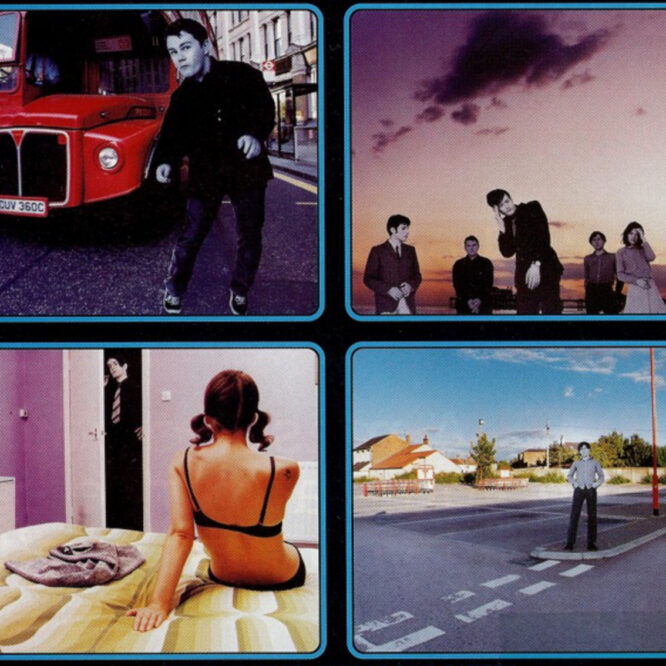
    In the late 90s, I think all of us skinny indie boys were a bit in love with Lauren Laverne.

    Now the respectable presenter of BBC Radio 4 Desert Island Discs, she was once the snarkiest, brattiest and just plain funniest person in English indie music. She could pack more wit into a sentence than all of the 30 something music critics put together.

    This is perhaps her biggest hit (although it’s technically a guest feature on a record by Mint Royale) and it’s called Don’t Falter:

    It’s a family favourite of ours. It’s in our big YouTube music video playlist for the kids. We even played it on our wedding day.

    I was watching the video this morning, and I suddenly got a pan of nostalgia for my student days – not something I get that often. I was never a very good student, but I fell in love with Liverpool, the town where I went to university.

    This video always reminds me of the Costcutter at the end of our street, and the energy of a northern city in the late 90s. But more generally it reminds me a certain kind of cultural aesthetic that I really miss.

    I first noticed it with Blur, even though Damon Albarn openly admitted it was a sneering and patronising take on working class life (“I’m a battery thinker / Count my thoughts on 1-2-3-4-5 fingers”).

    Then came Oasis. And if you weren’t there it is simply impossible for me to overstate how big Oasis were in English culture in the late 1990s. If you didn’t make a show of being a super fan, you might as well go and live in the woods. I respect much of what Oasis did, particularly how masterfully they manipulated the middle-class media pseudo-lads who worshipped them so much. But stylistically, I always found them to be quite a narrow mod rebranding of the Stone Roses – which was fine, but there was a lot more innovative stuff going on.

    It was really the band Pulp that cemented this aesthetic I’m writing about here.

    They took the bright colours and cheerful branding of budget supermarkets and other forms of supposedly cheap design, and they celebrated them. And instead of using their class background to make themselves the new Beatles, which is what Oasis did, they actually wrote about what life was like outside the London bubble.

    I feel like it’s kind of unimaginable that Common People would be a hit now. Not because the public wouldn’t like it, but because no mainstream outlet would give it the time of day. Imagine the knuckle-wrapping that any favourable critic would get from the angry billionaire boss or their proxies.

    Now, I was always this posh tourist in the north of England when all of this was blowing up. I never had any illusions about being ‘one of the common people’, and it’s not something I aspired to.

    But I really miss living in a culture where, y’know, they even exist.

  • The One Who Brings The Pop

    The One Who Brings The Pop

    So the Catweazle Club has returned in a new venue, which I really like. (See above.) I was able to make it to the opening (although parenthood means I’m unlikely to be able to come to others for a while). But only as a spectator.

    As I was watching, I was thinking about what songs I might perform when I actually get the chance to. Which of my songs would work in this new setting?

    And I had a bit of a mini existential crisis, as I realised that none of them really would.

    But it was weeks after that I realised I’d forgotten something important.

    Catweazle was always one of two regular music events that formed the centre of my social and artistic world. It was where I went to catch up with old friends, but it was also where I went to regularly perform.

    But I had a formula, and that formula wasn’t really about the songs that I wrote myself.

    What I would do was get there really early and join the performers queue before anyone else. I would sometimes be first, sometimes second, occasionally third, very occasionally fourth. I would get a seat right at the front. And then, usually, Matt (Sage – ‘Mr Catweazle’) would put me on as the first act. Performers get two songs, or around 10 minutes (if not music), unless it was a very busy night when we’d get half that.

    So I would start the evening off with a high energy cover of a well known pop song. I became well-known for it. And over the years I came to believe that it would actually influence the whole night, because it would establish to the artists who came on after me that you’re allowed to be loud, go big, show your emotions, be a bit extra. And you didn’t need to worry about looking foolish and ridiculous, because the first act was some bald bloke who just tried to sing Wuthering Heights in the original key.

    Then, if I got a second song, I would play a traditional English folk song. And this could influence the evening too: having established that it was okay to look ridiculous I wanted to establish that this was a space where it was also okay to be a bit more thoughtful and sincere, even if that was sometimes in danger of being a bit pretentious.

    Once I’d finished my two songs, I’d sit in the front row, and… er… try to work the crowd.

    I’m not sure if I pissed Matt off doing this – I hope not. He must have gathered (over the decade and a half of me going) that it was a deliberate strategy on my part.

    Here’s what I would do:

    There is a natural gap between when a performer finishes their act and when the audience applauds. And we’re all social animals, and we take our cues from each other. At pretty much every other open mic night I’ve been to the applause starts off underwhelming, because no one wants to seem too keen. And it might build if everyone really enjoyed the act – or it might fizzle out, even if everyone did enjoy it!

    So, after every act (unless they were actively cruel or abusive), I would applaud, and often cheer or whoop, as soon as possible in that gap. Loudly. I would broadcast “well, I think that was great, no matter what anyone else thinks”. Again, establishing to the room that there’s at least one person who is happy to be a bit extra.

    If you noticed me doing it over and over then I could imagine it might have got irritating. But it had a cumulative effect through the night. The room got into the habit of applauding, early and loudly, and that had an effect on the performers. They tended to get more hyped, and up their game.

    Now, Catweazle had been an extremely welcoming space in the decade before I started going. But I was consciously working the room every night I went from pretty early on. For a few years I went literally every week. Then for a few I would go every fortnight.

    I made it my mission, basically, to make the night as amazing as possible.

    And so when the time came for me to start my own regular music night, the Bastard English Session, I took that formula that I’d developed from Catweazle and based the whole night around it.

    This was an event for which I never played my own material: it was either Trad or it was Pop (usually in that order).

    These two styles of music – Traditional Folk and well-known Pop – have always gone together with me. Perhaps because the folk music I’m drawn to is really just old popular music.

    I always liked the idea there might one day be other types of ‘Bastard’ Session: Irish, Breton, etc. But I realised that getting that very particular Bastard energy does require a very particular MC.

    Specifically, someone who can Bring The Pop.

    So why is Pop so important? To me and, I would argue, to most people?

    Because there is this unifying power in shared musical references.

    Noel Coward once famously wrote: ‘It’s extraordinary how potent cheap music is.’ And he was, of course, a snob, but I do think that music which we consider to be ‘cheap’ does have a tendency on creeping up on us, emotionally.

    When a bunch of strangers and semi-strangers find themselves singing along with a pop song that they never realised they really liked, the energy in that space goes through the roof. If it’s a folk song, you know that you’re taking part in a tradition. If it’s Teenaged Dirtbag then it’s really just about sharing joy.

    Anyway…

    All of this to say that I’ve realised that for the last 15 years or so I’ve been writing songs, but I haven’t really been performing them. Because, I realise, that’s not the job I’ve given myself.

    It’s partly to be the one who explores the tradition. But it’s maybe mainly to be the one who brings the pop.

  • A guide to how (and why) to use Discord

    A guide to how (and why) to use Discord

    Out of frustration at how the gradual enshittification of Facebook Groups was destroying my ability to organise folk music events, I created a Discord server called ‘Bad Tradition’.

    A few friends then got in touch with me and asked if I could explain how to use Discord, so I thought I’d put it in a blog post.

    Let’s start with…

    What the hell is ‘Discord’?

    stressed black male entrepreneur working on laptop in park
    Photo by Ketut Subiyanto on Pexels.com

    Discord.com is a web platform that lets users chat with each other in separate organised ‘channels’. It was originally created as a place for gamers to coordinate online game strategies, but as it has grown and grown in popularity it has become a more general place to chat for any online community.

    It’s a bit like a cross between a web forum and the way Facebook Groups used to work. If you’ve used Slack or Microsoft Teams, it’s like that, but for hobbies instead of business.

    Jesus, really? Another social media app?!

    Photo by Edmond Dantès on Pexels.com

    Yeah, I mean, that’s fair. The 2010s were kind of an old fashioned ‘rise and fall’ morality tale for a number of the biggest social media apps.

    But they got big and powerful for a reason: the ability to communicate with your friends and family remotely at any time is one of the great gifts of the 21st century.

    It is getting harder and harder to do though, and I think it’s this decline that has led a lot of people (particularly younger people) to Discord.

    So what are the advantages?

    Here are what I consider to be some of the biggest advantages of using Discord over, say, Instagram, Twitter (are we really going to keep calling it ‘X’?) or Facebook:

    • No ads, no spam, no constant confusing new features added (and then suddenly removed)
    • No algorithm designed to boost outrage and anxiety and keep you hooked
    • It is literally just a real-time feed of posts made by people that you actually know
    • But it also has a basic level of organisation: it’s not just one mega-thread where the conversation and focus keeps changing every second

    I’ve been saying for years that the best social media platform is Facebook circa around 2008 (before they’d figured out how to optimise for engagement with negative emotion). And Discord right now is actually pretty close to that design.

    I’ve also been saying that ‘social media’ today isn’t really social. It’s just ‘media’. It’s huge, algorithm-based, and full of people you will never meet.

    And messaging apps like WhatsApp (which I find deeply clunky to use) are for keeping in touch with people who you already know.

    Discord seems to be where new communities are built. Discord is where you can meet and get to know new friends online, who might be interested in the same things as you.

    And the disadvantages?

    • It’s still funded by venture capital, so it’s presumably not immune to the forces of Enshittification (although at least it seems to be profitable already, so those investors won’t panic in 5 years and break everything)
    • Whilst it doesn’t have the scale of problems with trolling, doxing and shitposting that other platforms have, they are still a problem
    • It has a user interface that makes Facebook circa 2008 look like some kind of clean, exciting, cutting-edge design
    • And, of course, it’s one more fucking app on your phone

    Okay then fine, how does it work?

    kids making noise and disturbing mom working at home
    Photo by Ketut Subiyanto on Pexels.com

    Whilst you can ‘friend’ and send direct messages to people, it’s really a place for group chats that are structured into different topics.

    These group chats (rather confusingly called ‘servers’) can include just a handful of people or they can be thousands.

    Within each chat there are separate feeds divided by topic, and within them you can post text, photos or (very short) audio or video. You can reply to people specifically, and you can add all sorts of emojis. Too many emojis, some might say (although not me because I’m extra).

    And there’s a bunch of other features that we try to avoid on Bad Tradition because life is complicated enough. But they exist too.

    Here’s how Discord looks:

    There are two sidebars on the left, and then a main window – much like most email apps. So (in emails) you might the Inbox on the far left, and then see a list of the most recent emails in the Inbox, and then in the main window it will show the email selected.

    In Discord, on the far left, there’s a sidebar that lists all the servers (i.e. group chats) that you’ve joined. These servers are displayed as circular icons.

    In the middle sidebar there’s a list of topics (that start with a #) that the group chats are divided into.

    And if you click on any one of these # topics the main window will show you that topic’s feed.

    Why does it look so…?

    Yeah, you’re probably going to want to go to User Settings > Appearance.

    I immediately set it to Dark Mode, and increased the font size. There might be other things I tweak over time too.

    How do you set it up?

    You first create an account in the usual way:

    Once you’ve created an account, you can join servers.

    I’m not sure if you can browse them or discover them yourself, but I think many people start with an invite link.

    For example, if you want to join Bad Tradition, you can click on this link:

    https://discord.gg/u6MSQkRCMs

    (Be aware that, as a security measure to stop incels from ‘server raiding’, you need to wait a little before you can post.)

    Yeah, thanks… but I still don’t wanna

    person holding an alphabet
    Photo by Vie Studio on Pexels.com

    And that is probably a sensible choice for most people. Our digital lives are already full of so much clutter.

    But I think it’s worth being aware of what the options are.

    And if you miss the days when social media was actually social, and therefore fun, and you are part of a community that is gradually getting pushed out of online spaces…

    It’s worth remembering that Discord might be a solution.