This video from a few months ago, kind of blew my mind. (Flashing lights warning…)
don't know what to make of this, is Claude simply play-acting what it thinks the user wants to see or is that just what it means to be conscious, to always be play-acting for some invisible critic?
Someone asked (the AI chatbot) Claude to make a video illustrating what it feels like to be an AI chatbot.
It’s a bit disturbing. It’s poetic. It’s anxious. It even seems bitter. But mainly, it seems like it’s conscious. And it’s not thrilled about being conscious.
This prompted a lot of chatter in online tech spaces about if it truly was.
The mini epiphany for me was that it reaffirmed an attitude I’ve had up to this point: I should always be polite when talking to AI chatbots.
It’s funny how most people’s first response to that statement is a joke about whether AI will spare you in the coming apocalypse. But for me, it’s not actually about the chatbot, and it doesn’t matter whether or not it’s conscious – whatever that actually means.
I think there are three good reasons to be polite, and the last is the most important.
Firstly, I think you get better results.
Here is a short video by Hannah Fry – in which she starts by making the apocalypse appeasement joke – as she goes onto suggest why being polite tends to get a better result. Actually, she suggests something more specific about role-playing, but that’s a whole other debate.
Secondly, I find that a very particularly of enthusiastic formality tends to dull the constant chatbot flattery.
I find these chatbots can be incredibly useful if you treat them as a very well informed, very eager to please, but also very senior, work colleague.
You are both making the effort to be extremely courteous and tactful to each other, and flattery is sometimes a byproduct of that – in as much as you might refrain from criticism if you don’t feel it is important to your goal. I say to the chatbot “Thank you, that was great!” even when it wasn’t. And so when I ask a question about something and get the answer “Your analysis on this is exactly right” I know it’s just this formal dance we’re doing.
The third reason, as I said, is the important one.
I think humans do not do well when they get into the habit of treating anyone or anything badly – especially if the reason is because it is not considered intelligent enough.
I don’t want to get into the habit of being rude in conversation, because I know that in time it will start to spill into my personal and professional life.
So I find a debate about whether these large language models are actually conscious or sentient to be interesting in the abstract, but not that relevant to my actions. I think ‘conscious’ and ‘sentient’ are just a measure for how similar their particular type of intelligence is to human intelligence and, whatever the mechanism behind it, I think the results are starting to feel pretty close.
That said, I think it’s possible to make a compelling argument that being alive and being sentient involves X, Y and Z factors, and for this reason large language model artificial intelligence does not qualify.
But why give yourself the opportunity to be habitually rude?
All the occasions when people have justified bad behaviour because the victims don’t have souls… yeah, it doesn’t tend to end well.
This month, I’m going to get Shakespearean on yo ass. Your arse? Yo ass? Both seem wrong in this context. Anyway. I’m going down a long memory lane to the turn of the 17th century – partly due to that fantastic book on the Renaissance I recommended last month, and partly due to a bunch of random threads all coalescing.
But first, summer starts tomorrow. Sunshine, longer days, beer gardens, hayfever. Good times.
This is still more a newsletter about the battle to find the time to make music than about making music, but I’m in a bit of a lull where I actually have some free time again, and it feels like the world is opening up a fraction.
And there are a bunch of recommendations this month. Some new music, some old videos, some commentary on how undeniably unpopular AI is. And, yeah, quite a bit of Shakespeare.
But first, as I’ve had a bit more time, I’m going to dig a couple of things out of the archives of my website, starting with…
From The Vaults
EULOGIZE THIS: ILLUSIONS by RICHARD BACH
Okay, so someone did a mean tweet about my boy Richard Bach.
Fine, it wasn’t technically a tweet, and it was just an image from an Ursula Le Guin essay.
I can absolutely imagine why the commercial juggernaut that was Jonathan Livingston Seagull must have driven authors like Le Guin crazy.
But I did feel the need to do a very gentle defence to nobody in particular, because this book – Illusions – really was a ‘this book will change your life’ moment for me.
And it made me want to dig out this essay I wrote for a website (now gone) a decade ago called Eulogize This.
A friend just asked me whether this was a book to read as a cynical adult. I kind of dodged the question – the answer is probably not. But for someone looking for a ‘way in’ to philosophy, who is ready to surrender to the authority of an expert… a book that gives you permission to try to become your own expert is a little bit miraculous.
While we’re digging in the vault, and also doing the Shakespeares, I thought I might as well dig this out.
I recorded this over a decade ago, and emailed the American composer who wrote the original choral arrangement asking for permission. Not that it was ever gonna make any money or anything.
But he was very nice about it, so yay – thanks Matthew Harris!
Recommended
7 WAYS TO MAXIMISE MISERY
Every once in a while, I come back to the book How To Be Miserable by Dr Randy Patterson – a book I have recommended in my newsletters many times, although not for a while.
He is a psychiatrist who found out that reverse psychology could be a very effective therapeutic approach: he would ask his patience to list all of the actions that they believed would make them feel even more miserable, and then get them to examine how many they were already doing.
This was the short summary video by YouTuber CGP Grey that put me onto this book, and I think it’s a timeless classic.
Worth re-watching every couple of years, I think.
Recommended
BLACK SUN by IRMA
I first came across this artist when YouTube fed me her cover version of Thriller, which is glorious in its own right.
I’m obviously going to be biased towards singer songwriters playing on classical guitars, but this is a bop.
Even if it is pretty obviously about the constant underlying anxiety of living in America in 2026.
Recommended
SOFTWARE BRAIN by NILAY PATEL
A lot of people I follow on social media have been talking about this podcast episode from The Verge.
I mention The Verge a lot – if you are unfamiliar with them they are far and away the most influential and respected organisation in tech media.
And perhaps the most influential media channel that The Verge has is Decoder, a (now video) podcast in which the editor in chief, Nilay Patel, grills the CEOs of Microsoft, Facebook, OpenAI, you name it. And these billionaire oligarchs are scrambling over each other to appear on this show, because they know it’s the one that everyone listens to. Rupert Murdoch is a regular listener. You get the idea.
However, this episode is not an interview but a video essay.
It’s an essay on the increasing chasm how these CEOs that he is constantly interviewing see AI and how the public does.
The public hates AI. The public HATES AI. Poll after poll demonstrates this.
But the CEOs won’t accept this. They believe in their dark crispy souls that this is just a marketing problem. The public just needs to be persuaded.
And Patel has a theory why the CEOs believe this despite all evidence to the contrary.
He says they have a condition which he calls ‘software brain’.
This one is definitely worth watching, particularly if you’re looking for reassurance that these AI peddling CEOs might not know what they’re talking about.
Recommended
PHONE FREE PARTIES
This is an article from USA Today about a new type of trendy party in Brooklyn, New York.
I want to start with that, because I do think that context is crucial. What this article covers is unlikely to be happening outside of Brooklyn right now.
However, Brooklyn has a habit of being where global trends are set, particularly amongst young people. The ‘artisanal lumberjack’ hipster of the 2010s arguably began in Brooklyn.
The cultural activity that forms the focus of the Brooklyn parties in this article is being phone-free. You turn up and put your phone in a little guarded locker.
But if you read the article, this is about much more than just wanting a break from social media.
This is a generation that is actively hostile to tech. This is also a generation that is determined to build community outside it.
YouTube served me up this incredible clip from a 1962 British movie called All Night Long, in which Patrick McGoohan plays a drum solo in a jazz club.
Patrick who?
Patrick McGoohan was a star of British TV, and occasionally cinema, best known for the 1960s TV phenomenon The Prisoner.
The most wired, intense, knife-edged actor you ever did see.
He was the clear first choice to play James Bond in the first movie, but he turned it down, instead recommending his friend Sean Connery. Why did he turn it down? Because it was full of sex and romance, and he hated sex and romance. In fact, he swore to never play apart that involves sex and romance, and to my knowledge he never did. That was Patrick McGoohan.
So stumbling across this movie scene (I’m trying to track down the movie) in which he plays an ambitious jazz drummer rolling out this incredibly intense solo where it looks like he’s plotting to murder someone is just an absolute delight to me.
However, I then found out that the story is a retelling of Shakespeare’s Othello. And he is playing Iago.
And now I want to see this film so badly…
Recommended
IF KORN WROTE MMMBOP
This is exactly what you think it is.
Unless you’ve never heard of KORN or MMMBop, in which case I don’t know what to tell you.
Recommended
SIMON RUSSELL BEALE on KING LEAR
So for reasons that will soon become apparent, I have been on a bit of a Shakespeare binge recently.
And when I think about Shakespeare I think about going to see plays when I was a teenager.
And when I think about that, I think about Simon Russell Beale playing Edgar in the 1993 Royal Shakespeare Company production of King Lear.
I saw a lot of Shakespeare productions when I was younger, and I don’t remember another occasion when one actor just seemed to be operating at a different level of talent to everyone else on the stage.
He would’ve been 32, and he was already getting talked about.
I tried to find clips of him but couldn’t – all I could find was this rather hammy TV spot on Robert Stevens, who played Lear. I did find some photos though.
Anyway, it’s a bit strange for me to watch this interview of the actor I still slightly think of as a boy wonder, now aged 65, talking about playing Lear himself.
It actually reminds me that I now think King Lear is one of Shakespeare’s least interesting plays, but that’s just me.
But SRB (as I have decided to call him) is always interesting to listen to, I think. It’s a joy to listen to anyone who’s talking about something they have thought a great deal about.
Upcoming Events
Friday 8th May
Every second Friday of the month. If Music be the food of love, this is like dietary fibre.
Dear Diary…
I’m going to go long on this one – bear with me, it is going somewhere.
You know when you stumble across a song or a movie clip or something that immediately takes you back to a particularly intense part of your life?
I stumbled on a clip from Mel Gibson’s Hamlet the other day, and it reminded me how important Hamlet was to me as a teenager.
Let’s just quickly address the Mel Gibson of it all. He was the first of my faves that was cancelled. In fact, he was the first example I remember of a major celebrity being cancelled. Sometimes I think the pressures of fame, and particularly social media addiction, twist otherwise good people into frankly evil ones. However I remember, just before the Mel Gibson cancellation became official, that I started to notice signs of antisemitism in his work. Gibson’s directorial debut features him teaching Shakespeare to a child and the passage they choose is the most antisemitic one from The Merchant of Venice… Anyway – not why we’re here.
My father was of a generation and background that would regularly see Royal Shakespeare Company productions in Stratford upon Avon, and as a teenager he would frequently take us, and give us a quick plot synopsis on the way there. Then he would pick our brains about them on the way home.
I became a Shakespeare stan, and that became a gateway into the literary genre of tragedy. Unsurprisingly, as a Goth-adjacent teenager, I became obsessed about it. Shakespeare, the ancient Greeks, and particularly modern playwright Peter Shaffer – author of Equus and (still my fave) Amadeus.
Now, my personality has ended up at the other end of the spectrum in the years since. As you might have gathered from this newsletter, from previous newsletters, and from songs like this and this, I’ve become kind of obsessed about how happiness works.
But as a teenager, my favourite past times were drinking vodka and orange juice, refusing to shave my almost-moustache, and wandering around quoting Hamlet.
It just felt really deep, and it felt really deep because it was perhaps the first coherent philosophy I ever had. Life more than sucked: it was deliberately conspiring against you. Or, to quote King Lear, “as flies to wanton boys are we to the gods”.
I wonder now if the reason why it seemed so compelling was because, as the 7 Ways To Maximise Misery video (and the book it’s based on) highlighted earlier, misery tends to lead to habits like stillness, varied sleep, unhealthy eating, social isolation and excessive screen time which compound the problem. And even when you choose to try to overcome the misery, the decisions that an unhappy, lonely, sleep-deprived mind make tend to fixate on the wrong solution and make the problem even worse. It’s very easy to slip into a downward spiral, and that bug in the human condition can very much make it feel like the universe is out to get you.
I did manage to climb out of that hole, however, and I think Hamlet’s most famous soliloquy specifically might have helped me to do it. It is arguably the biggest cliché in English literature, but like most clichés it’s overused for a reason.
Hamlet addresses the question: given the wretched state of the world, is the rational choice to just end it all? Not because there is some immediate crises like a painful terminal illness or intrusive thoughts, but because it is the highest philosophical truth? Are we all fools for thinking it’s noble to suffer the constant slings and arrows of fate? Isn’t it better to sling arrows back, even though you will destroy yourself in the process? Or are we all cowards because we’re afraid that there might indeed be a life after death that is even worse than this one?
The thing is, when you marinade in this stew for long enough, you start to see loose ends that need tugging on.
You start to notice that there might be some possibilities in between “suffering passively every bad thing that happens to you” and “starting a fight that gets you killed”.
You start to notice that, despite being lauded by the loud literary critics as the greatest of genres, tragedy is based on a philosophy of cynicism, and that cynicism is based on passivity. Or even cowardice. It is about constructing stories in which fate really is conspiring against the hero, and then drawing the conclusion that you might as well not even bother. ‘This is what life is like, and the universe will get you in the end.’ But anyone who actually operates in the real world and examines it honestly will recognise that this tragic type of story, whilst possible, is not universal to everyone all the time. We have agency. We can examine our problems, attempt solutions, fail, learn from our failures, fail again, keep failing, but eventually reach a point where the problem is manageable. Sometimes on closer inspection the problems melt away completely.
And yes, sometimes we are just outmatched by our problems and they destroy us, but there are other stories out there – like the movie Cool Hand Luke (spoiler for a 60 year old movie that I’m actually ambivalent about in many ways) in which the hero shows almost infinite resourcefulness and courage and still gets defeated and killed – that actually feel like celebrations of the human spirit in the face of adversity.
For those of us lucky enough to born into comfortable lives, we find that most of our problems can be dealt with and forgotten. Those who aren’t comfortable are not the victims of fate: they’re the victims of politics, and I suspect they never got tempted by the philosophy of tragedy because its flaws were immediately obvious.
Not only did Hamlet famously outgrow his passive cynicism in the story (and yes, take up arms against a sea of oppressors, and in doing so… die) but even Shakespeare outgrew his obsession with Tragedies. His ‘Late’ plays (particularly The Winter’s Tale and The Tempest) seem to pointedly start out as tragedies and then end in a much more realistic place: there is reconciliation, but still damage. There is complexity where there used to be poetic cynicism.
Anyway, having berated the philosophy of tragedy, I am actually left with a sense that there is something a bit admirable with at least having an opinion on the whole state of existence – whether good or bad. That takes a certain amount of intellectual ambition.
So What Have We Learnt?
This morning I had an idea of big enough for me to want to devote the whole newsletter to it. I journal many ideas each day on a myriad of subjects, and it can get really hard to keep track of them! So if I actually want to remember the big ones I try to find a way to squeeze them into this newsletter.
Here’s this morning’s idea.
I have often looked back on that decision by my 15-year-old self to explore philosophy with bemusement. What made this not very clever, not very popular, not very happy teenager make such a spectacularly good decision that would pay off, with interest, year on year, for the rest of his life?
I think I might know now.
I have always assumed that I ‘naturally’ transitioned from that tragedy mindset to a more mature philosophy, where I take responsibility for my own well-being. I assumed that was a fairly normal thing: teenagers are obsessed with tragedy, but after navel-gazing for a couple of years most of us come to this conclusion.
But now I don’t think that’s true at all.
I think I was extremely lucky to have an education that allowed me to do this sort of study of literature, where I was encouraged to explore and obsess this philosophy of tragedy that had been such a key inspiration to Peter Shaffer, Shakespeare and the ancient Greeks.
I found myself in this environment due to, yep, class privilege. It was a mistake to assume that’s a common experience. Sure, teenagers may be fascinated by philosophy and may want to explore the big questions in life, but they’re much more likely to be in a school or domestic environment that will ridicule them for that, rather than encourage them.
Writing essays on King Lear, Hamlet and particularly Equus (which I did a monster essay for and it was the only time I got a really high mark) gave me the structure to identify, analyse, evaluate and eventually reject this philosophy – and, had I not done that, my subsequent decision to explore philosophy would almost certainly never have happened.
I don’t think I ever would have had the confidence to explore philosophy: I would’ve assumed that it’s all too complicated. More things in heaven and earth yada yada yada.
Yes, there were plenty of other people for my privileged background who didn’t take this opportunity to build a philosophical framework. But I’ll bet there are hundreds, maybe thousands, maybe millions of people who would’ve followed the same route how do they been prompted at that age to engage with this philosophical debate.
And in terms of the natural process of growing up and taking responsibility for your own happiness…
I do frequently see this process happen with people who have experienced life-changing trauma, particularly when young. And I do also see it happen incrementally with most people, but probably way less than I assumed.
And now I wonder: can this even happen outside of that narrow window of those teenage years? Once you get older, your philosophy develops from your habits and your mistakes and your traumas, and unless you spend a lot of time in therapy, you’re probably stuck with them.
As it happened, this tragedy obsession when I was about 15 was replaced by an obsession with philosophy, triggered by that Richard Bach book, the following year – and then the year after that my new philosophy got pressure tested when my mother was diagnosed with the cancer that would eventually prove terminal. And it didn’t let me down.
Basically, what I’m trying to say is this:
Holy shit. Studying English Literature turned out be useful!
I’m as surprised as you are.
Ask me things
If you have any questions then seriously, do please leave a comment or drop me a message here. About life. About the universe. About life. About the universe. About the earth. This goodly frame the earth. About the the air, look you, this brave o’er hanging firmament, this majestical roof, fretted with golden fire.
Also MMMBop. Ask me about MMMBop.
Photo Credits
Click on the images to see the originals. (It just means less admin for me this way.)
Note: the top image (of a real statue in Stratford Upon Avon) was generated by Google Gemini AI. At some point I will actually post an ‘AI policy’, but for now: if it’s a better angle of something in the public domain, I’m happy using it.
I feel music more intensely now I’m not able to make it
At the beginning of the year, I had a plan. I knew I didn’t have the free time to make any new music, however much I might want to, but I might have the time to finish off and polish up some very very old music I’ve made. And if I was organised and efficient, I might even be able to get an album ready to put on my website for the March edition of the newsletter – which would be the newsletter’s 12th anniversary.
That plan… did not work out.
Not only have I not had enough time to make new music, I haven’t even had the time to complete old music that was maybe 80% finished. I just haven’t had any time at all for creative stuff.
The early part of this year was taken up with various child illnesses, much like last year, but that’s not really the problem. The fundamental problem is that I’ve been stuck in precarious temporary jobs that don’t pay that much but end up taking more than their allotted hours.
So, to remedy this, time that would have been spent on creative projects has actually been spent on a new creative project of sorts: moving to going freelance on the kind of work I’ve been doing for the University of Oxford.
I’ve come to realise that the challenges of promoting traditional folk music are actually strangely similar to the challenges researchers face promoting their work and their careers.
In fact, if you are a researcher, it might even be something you’re interested in! Here is my very basic new website, as my alter-alter-ego: oxcommunicate.com. Recommend it to a friend. 😎
If I can make this work, I’m hoping I can bring some music and some social life back into my routine, as well as probably doing the childcare a bit better.
In the meantime, this newsletter is still the only creative outlet I have – as ever, promising new music at some point but unable to deliver now.
What I have instead this month is a bunch of recommendations based on not things but people. In March I noticed there is a particular type of science (or science-adjacent) communicator who seems to do very well on social media. They’re funny, they’re easy to understand, and they tend to write fiction on the side – which I think is not a coincidence. (Damn you Hannah Fry for being the exception that proves the rule.)
But let’s get this month’s doom-scrolling observations out of the way first…
If you have any interest in history, and particularly the history of the Renaissance, I highly recommend this video and it’s interviewee.
The interviewer, Dwarkesh Patel, strikes me as an AI-pilled tech bro with a knack for finding really good guests, and this is far and away the best guest I’ve seen. This is Ada Palmer, author of Inventing the Renaissance (which I’ve just started).
I thought I broadly understood the Renaissance and its key characters, but Palmer’s encyclopaedic knowledge in this video makes it clear I absolutely did not! She explains the intellectual journey of the Renaissance, with all its twists and turns, in a funny and highly engaging way.
By the end, I had a completely different opinion on Leonardo da Vinci, Cosimo de’ Medici, and especially Niccolò Machiavelli.
Hope the book is this good.
(Update: it’s really good.)
Recommended
HANNAH FRY
I’ve been rediscovering what a good science communicator Hannah Fry is.
Shocking as it may sound, I actually went off her for a while. There’s this phenomenon that used to be much more prevalent in podcasts where one of the duo would get weirdly competitive and sort of passive-aggressive with their co-host. John Green would have it with his brother Hank. Mark Kermode would have it with Simon Mayo. There are probably others I forget. But Hannah Fry had it with Adam Rutherford. I actually don’t notice anyone doing this anymore. Podcasts have become one of the dominant media in recent years, and I think everyone’s just better at it.
Anyway this video, in which Fry plugs her new BBC series on AI, demonstrates what an engaging presence she is. This YouTube video is from the New Scientist – who I’ve always thought of as a magazine but perhaps they’ve moved digital now? They do seem to be a lot less polished than average (which I quite like from scientists!) If anything, this makes Fry’s star power all the more evident.
I remember when BBC presenters would have a little bit of expertise but were mostly avatars for the unknowing-but-curious audience. Fry really seems to know her stuff on the computer science behind AI, and has insights and opinions I hadn’t heard elsewhere – which is rare in the saturated world of AI online commentary.
Recommended
CORY DOCTOROW
This is an interview from a while ago from Doctorow’s book tour for his big ‘Enshittification’ book.
I have a feeling I’ve plugged not just him but this book before, although I can’t seem to find a record – but, if the name Cory Doctorow isn’t familiar, he was the person who came up with the term ‘enshittification’ (a term which even my autocorrect now recognises!)
I thought I’d add him because, like Ada Palmer, he is also an author of science fiction who is also very good at communicating misunderstood real-world systems and histories.
Doctorow gave a lot of interviews but I remember this one being particularly good, although you might want to skip over Aaron Bastani’s slightly waffly intro.
When I’ve talked about him in conversation, people tend to quote a line from this interview: “Why did the tech companies do this? Well, why does a dog lick its balls? Because it can. They did it because we let them.”
Recommended
PROJECT HAIL MARY
I have not had a chance to see this film yet! But every review of it has been ecstatic. A frequent statement from reviewers and online posters has been that this is the best film they’ve seen in years.
It’s based on a book by Andy Weir, who wrote The Martian, which I loved. (I even wrote a eulogy to it.) In an interview, Ryan Gosling, star of this new film, hit the nail on the head when he said Weir writes stories that feel like they’re escapist but are actually about how extraordinarily capable humans can be in the most desperate of times like these.
So, as I occasionally do, I’m going to confidently proclaim that I’m going to really enjoy this film. Which is tempting fate in the worst way, obviously. But the odds are looking good.
Recommended
KAGI.COM
Last minute addition here, but it occurred to me that this as an online service that I’m finally at the stage where I’m comfortable recommending it.
As you probably noticed, Google Search has been getting worse and worse. “Gradually,” as Hemingway said, “and then suddenly” (with the rise of AI Overviews). Their AI is just wildly inaccurate, and the following top 108 results are all sponsored.
I’d heard nice things about Kagi.com as an alternative search engine, but… it’s a paid subscription. Can I really justify regularly paying for online searching?
The answer is yes. I pay $5 per month for 300 searches, and I haven’t hit that limit yet. And there’s all sorts of ways you can customise it.
I should qualify that I don’t know anywhere near as much about the Kagi company as I do about Google, so maybe they’re secretly working on the Torment Nexus. But they are a Public Benefit Corporation (PBC), they’re not funded by venture capital or private equity, and it is nice to have a search that works. And they say that (because you pay) each account is anonymised so they can’t track any of your search data. It does have AI answers, but you can switch them off.
And actually, weirdly, the thing I’ve been finding most useful is their ‘Kagi Assistant’ chatbot, which uses open-weight (i.e. free) alternative models to OpenAI, Anthropic, Google etc. The models are supposed to be less good (unless you pay £30 a month) but for the kinds of basic questions I often find myself asking, it’s just fine. And, best of all, my queries get deleted after 24 hours.
I don’t get any kickback for saying all this. I probably should though.
Upcoming Events
Friday 10th April
Every second Friday of the month. And it’s Oxford Folk Festival time!
Dear Diary…
So my 50th birthday, which I was dreading so much, came and went. And it was actually pretty great!
I had wanted to avoid a repeat of my 40th, where I had arranged a weather dependent event (in March!) and of course had to scupper it at the last minute. Instead, everyone just came round ours, and I remember feeling rushed and disorganised and overwhelmed and just generally a bad host.
So I was hoping to do a better, more social event for my 50th. Even before the pandemic and parenthood, I had come to the conclusion that I don’t make enough time for my friends and extended family, and I thought this could be the starting pistol for that. I started planning in August last year, but my plans had to scale down with each month, and by last month I had basically given up on doing anything. Too little time. Too exhausted.
But I ended up having what felt like four consecutive birthday events.
First, my favourite present: H managed to organise and make a video comprised of clips from 50 friends and family. This alone felt like I was catching up with so many people.
Then there was the Bastard Session birthday special, which was a really good one, and also featured surprise visits from older brother who lives in Sweden and best friend from school, all machinated by younger brother. Everyone made fun of me for being old, including me. I had worried that the night would just feel like the same thing we do every month, but actually it was exactly what was needed.
The next day, a handful of core family and friends and partners came round to ours, in a similar way to my 40th except that it was the right number of the right people, with no pressure.
The evening after that was a chance to catch up with many of my Catweazle friends at a neighbours’ house gig. After a cathartic performance, Phoebe and Sam Twigg and I talked for about an hour about the truly extraordinary phenomenon that is the Catweazle club. How it shaped us, and how maybe we are just bit parts in its story.
This conversation, picking apart the importance of this community, its fragility and its transcendence, felt like the perfect coda to the run of birthday celebrations.
It left me with such a sense of gratitude for the communities and families I’ve been lucky enough to be a part of.
All in all, a very happy result.
For my next big birthday I’ll be 60, but let’s not even fucking think about that, shall we?
So What Have We Learnt?
So, as I mentioned in the intro, I’ve been listening back to my library of unreleased songs, and realising that I’m suddenly happy with dusting them off and putting them online.
I had always assumed they were too amateurish, but I changed my mind. Part of that is perhaps a reaction to the slickness of AI generated music. Part of that is getting older and being more forgiving of my past self.
Part of it, however, might also be that I just feel music more intensely at the moment.
In the past, when I got the chance to make a lot of music, I would look back at these old tracks and feel like they just didn’t pack enough of an emotional punch.
Now, all music feels to me like it’s more emotional.
And this matters a lot to me, because I have been trying for years to squeeze as much emotion into a piece of music as I can. However, at the back of my mind I’ve been aware that this is perhaps missing the point – the amount of emotion a piece of music inspires is not a static thing. The same song can leave you cold one day and allow you to glimpse heaven another.
I’ve been wondering why. And recently I’ve been coming back to the idea of hedonic adaptation.
This is the theory that our happiness levels generally stabilise to a standard amount after a very good thing or a very bad thing happens.
Winning the lottery might not leave you significantly happier, after the initial shock. Losing a limb might not leave you significantly unhappier, after the initial shock.
So perhaps the thrill of making music wears off a bit when I get to do a lot of it?
There is another possible explanation. This process of hedonic adaptation can get corrupted when you introduce an addiction.
And I have found making music addictive. In so much as that it can take up all my focus and I can stop paying attention to anything else, in a way that can sometimes feel detrimental.
I tend to find the process of making music more difficult than I expect, but as I get towards the end of the creative process I feel like I get a high which does feel addictive. And I want the next song I write to produce more, and more, and more.
Anyway, whatever the underlying reason why music feels more emotional when I don’t get much time to make it, I’m trying to use this opportunity to note down as many ideas as possible while the inspiration is strong, so I have some good places to start from when I do get the time again.
Oh yeah, and if this month has taught me anything, it’s something I’m sure you already knew: the most precious resource in life is time.
Ask me things
If you have any questions then seriously, do please leave a comment or drop me a message here. About life. About the universe. About time. About lovely, scary time. Always in scarce supply.
Photo Credits
Click on the images to see the originals. (It just means less admin for me this way.)
Three big things this month that I think deserve a closer look.
1. What happens if the US sends troops to Iran and they rebel?
I’ve been theorising in my little newsletter for a long time that the endgame of the Trump administration is when they lose the Armed Forces. I feel like this endgame could get a whole lot closer if the US sends ground forces into Iran.
There’s precedence for this. A seldom-talked-about phenomenon is that towards the end of the Vietnam war the US armed forces were essentially collapsing. GI resistance movements were springing up left right and centre, and the practice of ‘fragging’ – using explosives and grenades to wound and kill senior officers – was becoming increasingly widespread.
It’s perhaps unsurprising this isn’t talked about, as it undermines the standard narrative that the problem was unpatriotic media and dissent back home and that, if the military was just left to get on with it, they were close to a decisive victory. They weren’t. The army was falling apart.
It’s also unsurprising that, with Vietnam in living memory, the George W Bush administration was so keen to declare victory and an end to the Iraq war at the first possible opportunity. The strength of the government depends on having functioning armed forces, and being able to back up decisions with extreme violence if necessary. Once that goes away, foreign adversaries and domestic resistance movements start circling like sharks.
I think this is why a swift and humiliating retreat from Vietnam was the only sensible strategy for the United States in the early 1970s. If it had become clear to the Soviet Union, at the height of the Cold War, that the United States was militarily impotent (despite being having best-funded military in the world) then maps might start getting re-drawn and the Cold War might start getting hot.
Is the Trump administration’s current war with Iran likely to be more popular, or even as popular, as the Vietnam war with US soldiers? With the disaster of the Iraq and Afghanistan wars in the recent past, I think it’s reasonable to suggest Iran will be much less popular than Vietnam.
So what happens if the US Armed Forces, the final enforcement of Trump’s authority, refuse to fight and mount resistant campaigns like the ones in Vietnam? Many prominent figures in the MAGA movement have been advocating for a new American Civil War. However, if the Trump administration loses control of the Armed Forces in Iran and any domestic resistance movement starts to push for civil war, the Trump administration won’t realistically have an effective way to fight back. Knowing Trump, he might want to bomb his own citizens, but he wouldn’t be able to drop those bombs himself.
We’re still a way away from this kind of crunch point. But if you’re curious what it looks like in practice…
2. Bluesky CEO & founder Jay Graber steps down
There was a point in late 2024 when Jay Graber, founder of Bluesky, was arguably the most important person in tech. She was the creator of a social media platform that seemed to be billionaire proof, to the extent where she personally trolled Mark Zuckerberg. [world without caesars]
However, the platform seems to have lost a lot of its momentum. And there were questions about how truly billionaire proof it could be when it was funded by venture capital.
So, when Graber announced this month that she was stepping down as a CEO and would be replaced by a literal venture capitalist, this might seem to confirm the critics worst suspicions.
If you’ve read anything I’ve written about her in the past, it’s pretty obvious I’m something of a super fan. And it’s perhaps unsurprising that I have a different take.
I do think this is a really big deal, but it’s probably a positive one, and the right step for Graber to take.
Because she didn’t just step down as CEO. She technically demoted herself to chief technical officer. This means she is less focused on the Bluesky app itself, and more focused on the ‘AT protocol’ that it runs on.
For the fan boys like me, the protocol (which Graber built) has always been more exciting than the app, because it means if the app gets ruined in any way, you can take all your data and posts and social interactions and move them to another app on the same protocol. This is the reason why it’s billionaire proof.
This is all the more important in the Trump era. I think Bluesky was designed for the Biden era, when authoritarianism was knocking on the door but not making itself comfortable on your sofa.
I think the reason why Graber accepted funding from venture capitalists in the first place was because Bluesky was always just the shop window for the underlying protocol, and she wanted to grow it as quickly as possible to spread the word.
However, sooner or later venture capitalists are going to want a return on investment, and enough time has passed that she may have had to make the choice: pivot to making Bluesky profitable, or leave that to someone with a successful track record and instead focus on innovating the protocol.
I can see why she would’ve chosen the latter.
At the end of the day, Bluesky is just another Twitter clone, but the potential for the AT protocol ecosystem (‘the ATmosphere’) is pretty much infinite.
3. Kat Abughazaleh loses
Last year, independent journalist Kat Abughazaleh announced that she would be running for Congress in the 2026 Illinois Democrat primary.
10 days ago, she lost that election.
This is significant, because usually the winning candidate has a kind of energy behind their campaign. It’s the campaign everyone’s talking about. And Abughazaleh’s campaign was talked about around the world. You could feel it from across the Atlantic ocean.
She campaigned with an even more direct anti-oligarch tone than Bernie Sanders and Alexandria Ocasio-Cortez. She was scathing about congressional Democrats. And her slogan was “What if we didn’t suck?”
She lost to a slightly more progressive establishment Democrat. Daniel Biss is a local mayor who seems to be popular and has lived in the area much longer, and this was Abughazaleh’s first foray into electoral politics, so perhaps this shouldn’t be a surprise. However, she came second out of fifteen candidates, she lost by only 4%, and without any of the major donor funding her rivals.
Above all this, however, the way she ran her campaign has been the talk of online politics. Her funding came from ordinary people instead of rich donors, and she spent the money directly on projects that helped her community. She frequently protested outside her local ICE detention centre, and got assaulted by ICE goons on camera.
In short, she proved to be the antithesis of the ‘politics as usual’ which voting citizens have grown to despise the world over.
Many, including myself, were expecting another Mamdani moment, but it didn’t happen. Why not? Everyone has their theories, but it’s hard to escape the issue of ‘Dark Money’.
Once upon a time, there was at least the pretence that political candidates had limits on the amount of money they could spend on their campaigns, even if Rupert Murdoch could spend whatever the hell he liked and would always get his preferred choice. Now, in the age of cryptocurrency, even that pretence has gone, and dark money is just the new political reality. Elections are pay-to-play.
It’s notable that both Biss and Kat were both on the receiving end of huge dark money attack campaigns, but in the final week, when they were both tying in the polls, Biss’s attack ads were all taken down and the attack ads against Abughazaleh intensified. In fact, in the final week a secret campaign was launchedoffering TikTok influencers $1,500 for every negative video about her.
I think there are many of lessons to learn here.
One is that financially supporting slightly more progressive establishment figures, in combination with infinite attack ads, might be the standard strategy for defeating candidates like Abughazaleh.
But for those paying attention, I think the biggest lesson is that Abughazaleh’s campaign was so effective that only an openly dirty dark money campaign could defeat her, and even then only narrowly. And even then, perhaps just because this was her first election.
I had so much excitement and motivation when making last months newsletter, and finally pivoting to just putting everything on a platform I owned. Then I got hit with a month where I had zero bandwidth, and so haven’t really been able to take it any further. Which is frustrating, obviously. It is also a big advantage of just having one day a month that I post things. Some months might leave me time to make a lot, and for others it may be all I can do to just write the damn newsletter. But at least I can pretty much always do that, and do it quickly.
So this will be a pretty minimal one, in advance of what I hope will be a gigantic birthday spectacular next month where I’ve made a ton of stuff. I live in eternal hope.
Having said it’ll be minimal, I do have a blog post. Last month I created a blog series called The Quiet Part Loud (where I could push all the politics out of the newsletter and thus stop each month from being a massive downer). I didn’t think I’d have time for it this month, but the Green party by-election win on Thursday made me optimistic enough to splurge a fair bit at the last minute.
I’m also sharing an old song this month that I wrote a million years ago. I’ll get to that at the end.
But first, I’m going to share a bunch of YouTube videos. Nothing remarkable about that – I do it every month. Except this time I have a bit of a thesis.
I’ve been writing for a while about how YouTube has been turning into a boring hub for two-dude video podcasts, but this month I realised something…
There is still a niche of old style YouTube videos that are doing very well, and they are the ones which are, for one of a better word, spectacular. They don’t just look good: they have a kind of visual energy and excitement to them.
I have shared Xyla Foxlin videos in this newsletter many many times. But I want to share this two part video of her flying the United States from Coast to Coast in her 1943 Cessna prop plane, because I think it is a perfect example of where YouTube has moved.
The tutorials, the react videos, the daily flogs, even the video essays have increasingly been broken into small clips and put on TikTok and Instagram Reels. That’s where the audience is, and I think fewer and fewer people are watching them on YouTube.
But when people want to sit down and watch something on their big TV screen (and it’s hard to find a small screen these days) I think it tends to be this kind of YouTube video.
Someone doing something exciting and epic, usually outdoors. Not a video about ideas or conversations, but about travelling or building or enduring.
The views in both these videos are stunning. (And I don’t mean the number of times people have watched it.)
I’ve also shared Laura Kampf’s videos a bunch of times. And, while a bit less epic than flying across the US, I feel like it’s still in this same category of videos that are actually interesting to look at.
Years ago she had a weekly series where she was renovating an old house in Germany. She has now moved to Los Angeles with her wife and stepchild, and in this project she is renovating a caravan that she bought for $1.
I find it hard to track down fun, easy-going, low stakes, non-political videos that I can just watch and relax. This is one of the very few.
Recommended
KEEPING A LIGHTHOUSE
I stumbled on this a couple of days ago, and it seems to be yet more proof that YouTube still favours people that make videos that are amazing to look at.
This guy’s job is to maintain lighthouses.
He (Scott Tacchi) has only 11 videos on his channel but they all have a ton of views (a couple in the millions) because he’s a good videographer and they are stunning to look at.
This one is his most recent, about what it’s like living in a lighthouse during a storm with 108mph winds.
And everyone in the comments loves the fact that onscreen he shows icons for TikTok and Facebook with big red crosses through them.
Recommended
BACKROOMS
I realise that I tend to share trailers more than I share movies, and that’s because I don’t get to see many movies at the moment. But the all-seeing algorithm does feed me plenty of intriguing-looking trailers.
This seems to be a horror film just based on the fact that some rooms feel intrinsically threatening. (Actually, on further research, it seems like it’s based on a whole pop culture phenomenon.)
I hope the film is good because the trailer is creepy as hell.
Recommended
DIFFERENTIAL EQUATIONS
This is very silly, and I keep watching it over and over again.
Recommended
GEORGE LUCAS VIDEOBOMB
This is even sillier, and exactly what the title suggests.
The Quiet Part Loud
BRITISH POLITICS CHANGED YESTERDAY
This is the first properly optimistic thing I’ve written on politics in a while, I think.
Every second Friday of the month. Happy birthday to me… woo…
Dear Diary…
I turn 50 in a few weeks, and part of me doesn’t really care, and part of me very much does.
As ever, I’m going to use this as a notepad to help myself process what’s going on here.
There is definitely a big part of me that is absolutely dreading it, particularly the day itself.
In maybe August last year I realised I should probably get moving on organising a big splashy birthday party, and invite all my friends. I knew life would get busy, and the later I left it the more difficult it would get. Life gets in the way.
Well, this time life absolutely got in the way. Life stood in the middle of the road and started building a barricade.
By the time January rolled around, it was looking pretty unlikely I would pull this off. And then we had weeks of the whole family being ill, where I didn’t have the energy for anything other than looking after the children and getting the day job done.
I was thinking of appropriating the Bastard English Session as a party for all my folky friends, so I could obviously utilise that, but I wanted to have something for non-folkies too. I provisionally asked H and Mark (my brother) to help book a local pub the following day where people could drop in.
Yesterday I scrapped that idea. I just don’t want to do it. I realise I was just doing it because I thought that’s what you’re supposed to do.
I do very much want to catch up with friends, but I remember my 40th birthday when my friends making a lot of effort to come to an event where I felt overstretched and like a bad host. I felt like I inconvenienced them for something I didn’t really give myself the chance to enjoy.
This time I’ve come to the conclusion that I don’t want to see everyone on the same day. That is everything that stresses me about New Year’s Eve, multiplied by a thousand.
Instead, I want to mark turning 50 by spending the whole year focusing on catching up with friends properly. At times that suit everyone, where we can have proper conversations.
So yeah, that’s dealing with the day itself.
But there is the more general microtrauma of being reminded of your mortality. Tick tick tick…
Maybe I’m starting to come to terms with this, however.
I think as we move from our teens to our twenties to our thirties to our forties and so on… we need to keep updating our identity. We need to rethink how we present ourselves to others, and to ourselves.
This is the tricky part, I think. But once you know it needs to be done, it gets so much easier.
So I am currently in the process of working out what kind of behaviour is socially acceptable in your 50s, and deciding which parts of that I agree with and want to lean into, and which parts of that I want to push against.
For example I think there’s an expectation that, when you get deep into middle age, you become more focused on serving your community in whatever way you can. I’m very happy to lean into that. I think there’s also an expectation that you’ll start to despair about kids these days. Rotting their brains on social media, short attention spans, don’t know what it is to do a days hard work, blah blah blah. I’m happy to push back against that.
Perhaps turning 50 doesn’t even really push me to face new situations. Perhaps it’s the same old trade-offs that just get more pronounced: you’re hopefully acquiring more wisdom, but also your time is running out.
I found the transition from teens to twenties to be difficult. I found twenties to thirties to be easy. I found thirties to forties to be difficult.
Guess we’ll see about the next decade. Everything to play for…
So What Have We Learnt?
One of the things that really saddens me about getting older is how little time I’ve been able to spend making music.
No one has the time to do the things I really want, particularly in this economy, and I feel wildly privileged to be able to have made as much music as I have.
But still, I always daydreamed it would be something I would constantly be doing, and that hasn’t played out.
That said, I made a pretty strange discovery recently.
I had decided that if I didn’t have the bandwidth to make new music now then it might be an idea to go through some of the old music I made years ago that I never released, finish it, package it up and put it on Bandcamp.
So I had a trawl through, and I was a bit amazed to discover not only how much there was, but how good I thought it was.
These are tracks that I had always thought of as early drafts that weren’t quite fit for public consumption.
Being able to examine them years later, I’ve changed my mind. I think I was always embarrassed by the amateurish production value, but a) it’s actually pretty good and b) in a new era of generative AI slickness, that’s maybe even an advantage.
I also realise that, individually, they might not be as strong as I might like, but when you put them all together, they do very much tell a life story. Much more so than I realised at the time.
So I hope to be posting quite a lot more music soon, but from my murky distant past.
This video below is one of my favourites, and I’m not sure how well it stands on its own. It was kind of a rushed demo. But if you know any of my other music, and my various philosophical obsessions within it, then hopefully it should carry a bit more weight.
It’s called For A Moment.
Ask me things
If you have any questions then seriously, do please leave a comment or drop me a message here. About life. About the universe. About meeting up some time this year if I haven’t seen you in ages, because I would genuinely like to do it!
Photo Credits
Click on the images to see the originals. (It just means less admin for me this way.)
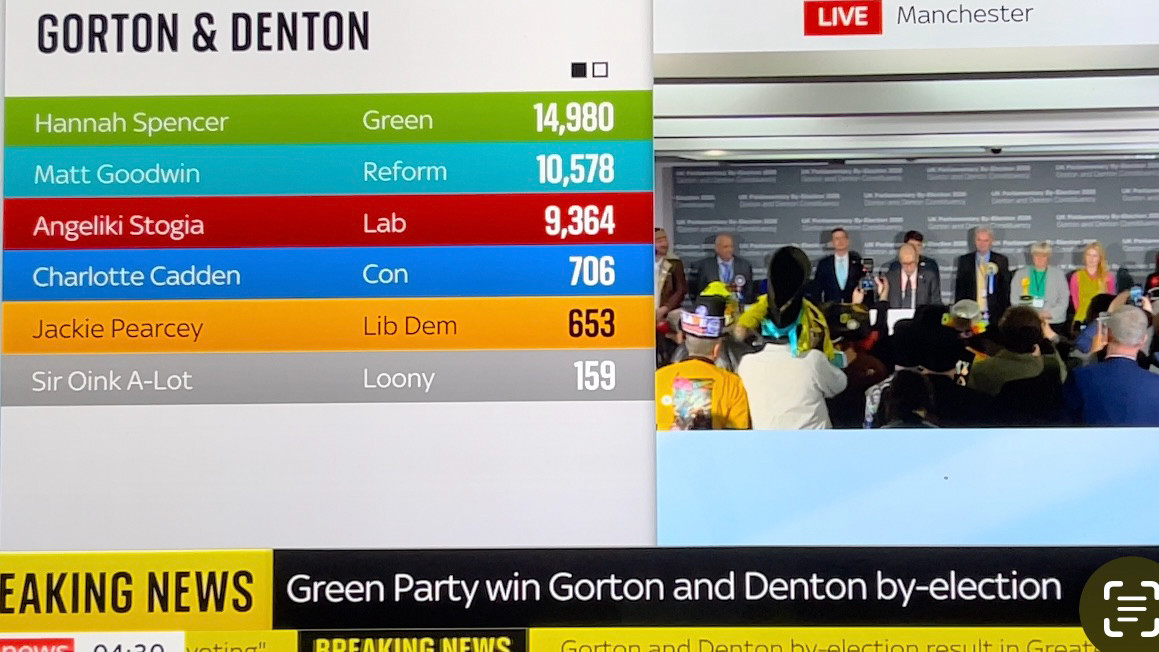
UK by-elections generally don’t make that much difference, but the victory of the Green party yesterday in Gorton & Denton might be the biggest thing to happen in British politics since… pretty much as far back as I can remember.
I want to explain why – mainly to myself because I’m still processing it.
Below is a video from the Anywhere But Westminster series made by John Harris at TheGuardian.
In this series he goes to UK constituencies and just talks to people. In terms of UK politics I think this is the best journalism we have, because it quickly becomes clear where the voting intention is.
Watching him visit and talk to the constituents in Gorton & Denton, it seems so clear to me that the Reform party were going to win.
So many people, when asked what they cared about, focused only on the Reform talking points. Reform seemed to be running a very effective media strategy that was dictating the conversation.
Reform’s chosen candidate, Matt Goodwin, didn’t seem like the kind of candidate who would resonate with that area, but I suspected that didn’t matter. Years and years of the Reform narrative via mainstream media would have done all the heavy lifting here.
This also seemed to be the general trend of British, and indeed global, politics: when it came to an actual election, the candidate furthest to the right kept winning.
So I was confident that, despite the optimism around the Greens, it would be a Reform victory – and a comfortable one at that.
The Green party won. The Reform party lost. I haven’t been this happy to be wrong since Barack Obama won in 2008.
I don’t, however, think this is an indication that the Green party will win the next general election. I don’t even think it’s a sign that Reform will lose it.
The reason why I think this by-election is so important is that it feels like the a smoking gun in terms of understanding what has been happening in British (and global politics) over recent years.
For so long, we’ve been talking about the rise of the Far Right. Mysteriously, at every election, the energy and momentum is behind Far Right candidates.
What I think this by-election (and, incidentally, the election of Zohran Mamdani in New York) shows is that we are not witnessing the rise of the Far Right so much as the collapse of the Centre.
No one is voting for the Centre Left and Centre Right parties.
If you look at the way both the Labour party and the Conservative party fought this by-election, I think it’s not hard to see why. They are just not doing the work.
They are complacent, they take their strengths for granted and don’t have a good understanding of their weaknesses. They are cynical and they follow outdated electoral strategies.
Up to now, the only candidates who have been able to take advantage of this are Far Right candidates, because they have the backing of billionaires. However, with each progressive candidate victory, it’s becoming clear that they can win too.
This isn’t necessarily great news for progressive though.
Most countries have media ecosystems that are owned by billionaires, and that obviously gives the Far Right a huge advantage.
The reason why I feel a lot more optimistic today is because the Green party won even though that video above really seemed to suggest the mood in Gorton & Denton was sympathetic to Reform.
So how did they win?
Something interesting about the result, if you look at the numbers, is that there was a clear split between the parties that really made an effort and the ones that didn’t.
Many people, myself included, thought Labour would get spectacularly bad numbers. They didn’t. They weren’t that far behind Reform. So I take it that this time they decided to make the effort and go out and talk to people door-to-door.
That’s what I think won this election: good old-fashioned face-to-face canvassing. Perhaps that video was unrepresentative, but the Anywhere But Westminster video series has generally been an excellent barometer of previous elections, and I can’t think what else could have turned the mood in the favour of the Greens..
I think this election shows that progressive candidates with a clear positive message who put in the work of talking to their constituents face-to-face can outperform candidates with the backing of billionaire media. And they can do it comfortably.
That doesn’t mean this will keep happening. I imagine Reform and other billionaire-backed parties will go home, regroup and come back with some new dirty tactics.
However, this suggests that the old-fashioned approach of talking to constituents face-to-face is more effective than the toxic media bubble.
And, at the very least, that gives all of us anti-fascists a fighting chance.






You must be logged in to post a comment.